Gönderi

Understanding Ethereum 2.0 Staking: Complete Validator Guide

Complete guide to Ethereum 2.0 staking and validator setup. Proof of Stake consensus, validator requirements, rewards, penalties, and best practices.

Understanding Ethereum 2.0 Staking: Complete Validator Guide

Introduction

Ethereum’s transition from Proof of Work (PoW) to Proof of Stake (PoS) through “The Merge” in September 2022 fundamentally transformed how the network achieves consensus and secures transactions. This shift not only reduced Ethereum’s energy consumption by over 99.95% but also introduced a new economic paradigm where ETH holders can actively participate in network security while earning rewards.

Ethereum 2.0 staking represents one of the most significant opportunities in the cryptocurrency ecosystem, offering yields typically ranging from 3-7% annually while contributing to the decentralization and security of the world’s leading smart contract platform. However, becoming an Ethereum validator or choosing the right staking method requires understanding complex technical requirements, economic considerations, and various risk factors.

This comprehensive guide explores everything you need to know about Ethereum staking: from the technical architecture of the Beacon Chain to validator requirements, rewards calculations, different staking methods, risks, and best practices for maximizing your staking returns.

What You’ll Learn

  • How Ethereum’s Proof of Stake consensus mechanism works
  • Beacon Chain architecture and validator responsibilities
  • Minimum requirements and setup for running a validator node
  • Staking rewards calculation and yield factors
  • Comparison of staking methods: solo, pooled, and liquid staking
  • Risks, penalties, and slashing conditions
  • Tax implications and best practices

Ethereum’s Proof of Stake Consensus

From Proof of Work to Proof of Stake

Ethereum’s original consensus mechanism, Proof of Work (PoW), required miners to solve complex computational puzzles to validate transactions and create new blocks. This process was:

  • Energy-Intensive: Required massive electricity consumption
  • Hardware-Dependent: Favored those with access to specialized mining equipment (ASICs, GPUs)
  • Centralization Risk: Mining pools concentrated power

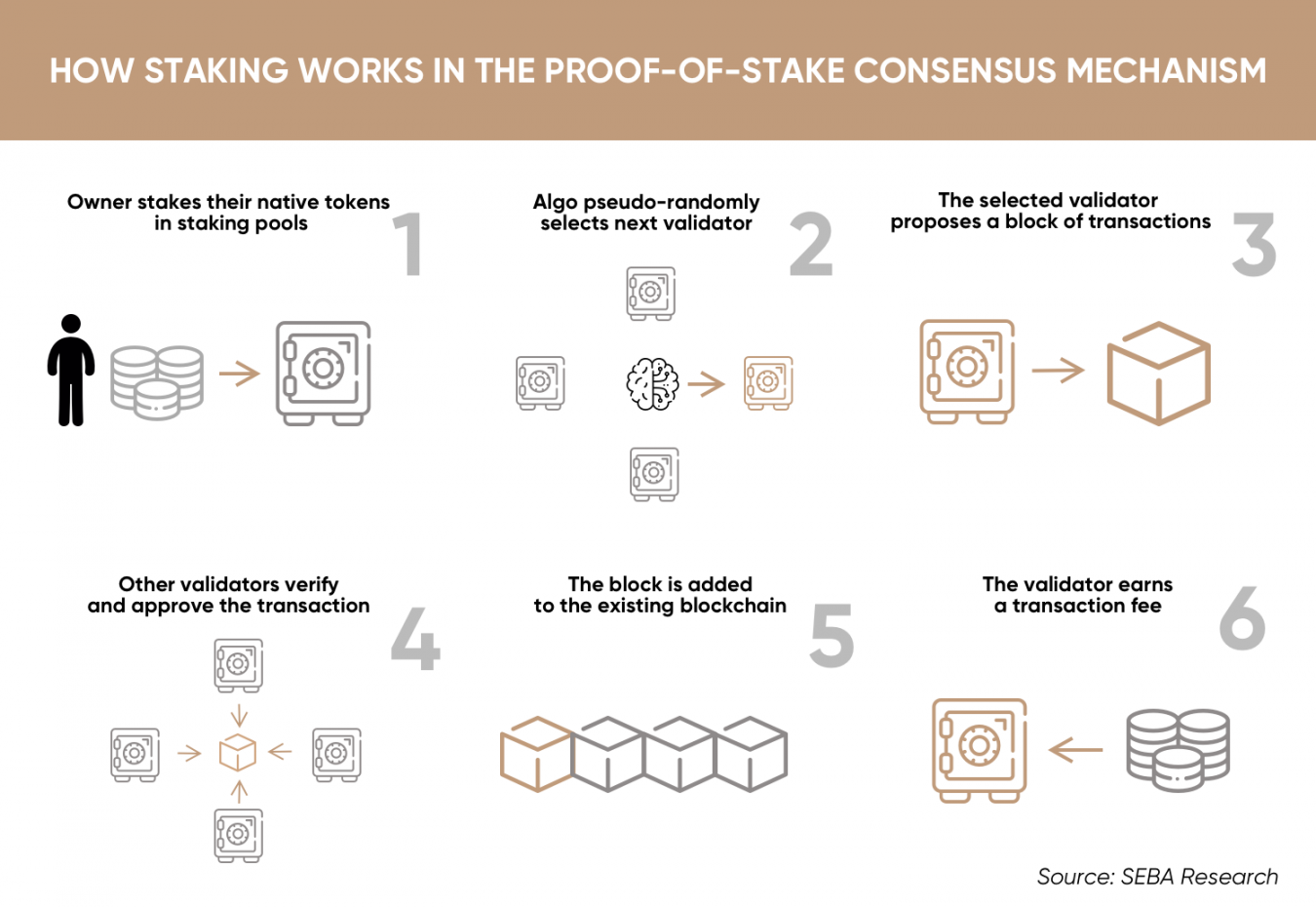
Proof of Stake (PoS) replaces computational work with economic stake:

  • Validators lock up 32 ETH as collateral
  • Random Selection: Validators are chosen to propose and attest to blocks
  • Economic Security: Malicious behavior results in stake slashing
  • Energy Efficient: Requires minimal computational power

Proof of Stake Mechanism Figure 1: Proof of Stake consensus mechanism - Validators stake ETH to participate in block validation

How PoS Consensus Works

The Ethereum PoS consensus operates through a sophisticated system of validators, committees, and attestations:

1. Validator Registration

1
2
3
4
5
6
7
8
9
10
11
12
13
14
15
16
17
18
19
20
21
22
23
24
25
class ValidatorDeposit:
    def __init__(self):
        self.deposit_amount = 32  # ETH
        self.withdrawal_credentials = None
        self.public_key = None
        self.signature = None
    
    def generate_deposit_data(self, withdrawal_address, validator_key):
        """
        Generate deposit data for validator registration
        """
        self.withdrawal_credentials = withdrawal_address
        self.public_key = validator_key.public_key
        
        # Create deposit message
        deposit_message = {
            'pubkey': self.public_key,
            'withdrawal_credentials': self.withdrawal_credentials,
            'amount': self.deposit_amount * 10**9  # Gwei
        }
        
        # Sign deposit
        self.signature = validator_key.sign(deposit_message)
        
        return deposit_message

2. Epoch and Slot System

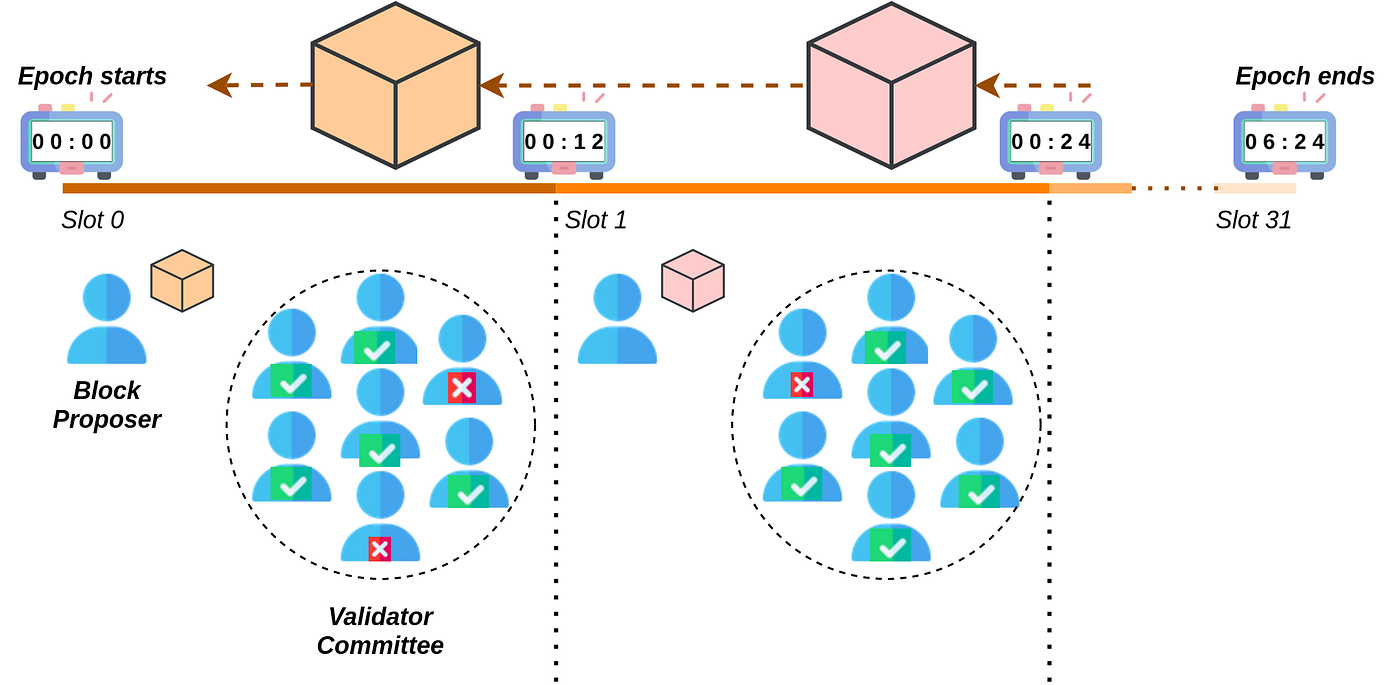
Ethereum’s time is divided into:

  • Slot: 12 seconds - opportunity for one block
  • Epoch: 32 slots (6.4 minutes) - checkpoint for finality
1
2
3
4
5
6
7
8
9
10
11
12
13
14
15
16
17
18
19
20
21
22
23
24
25
26
27
28
29
30
31
32
33
34
import time

class BeaconChainTime:
    SECONDS_PER_SLOT = 12
    SLOTS_PER_EPOCH = 32
    GENESIS_TIME = 1606824023  # Dec 1, 2020
    
    @staticmethod
    def current_slot():
        """Calculate current slot number"""
        elapsed = int(time.time()) - BeaconChainTime.GENESIS_TIME
        return elapsed // BeaconChainTime.SECONDS_PER_SLOT
    
    @staticmethod
    def current_epoch():
        """Calculate current epoch number"""
        return BeaconChainTime.current_slot() // BeaconChainTime.SLOTS_PER_EPOCH
    
    @staticmethod
    def slot_to_time(slot):
        """Convert slot number to timestamp"""
        return BeaconChainTime.GENESIS_TIME + (slot * BeaconChainTime.SECONDS_PER_SLOT)
    
    @staticmethod
    def next_slot_in():
        """Seconds until next slot"""
        current_slot = BeaconChainTime.current_slot()
        next_slot_time = BeaconChainTime.slot_to_time(current_slot + 1)
        return next_slot_time - int(time.time())

# Usage
print(f"Current Epoch: {BeaconChainTime.current_epoch()}")
print(f"Current Slot: {BeaconChainTime.current_slot()}")
print(f"Next slot in: {BeaconChainTime.next_slot_in()} seconds")

3. Validator Duties

Each epoch, validators are assigned to:

Block Proposal: One validator per slot proposes a new block

1
2
3
4
5
6
7
8
9
10
11
12
13
14
15
16
17
def propose_block(validator, slot):
    """
    Validator proposes a block for their assigned slot
    """
    if validator.is_proposer(slot):
        block = validator.build_block(
            slot=slot,
            parent_root=validator.get_head(),
            transactions=validator.mempool.get_pending(),
            attestations=validator.get_pending_attestations()
        )
        
        # Sign and broadcast
        signed_block = validator.sign_block(block)
        validator.broadcast(signed_block)
        
        return signed_block

Attestation: All validators attest to their view of the chain

1
2
3
4
5
6
7
8
9
10
11
12
13
14
15
16
17
18
19
20
def create_attestation(validator, slot, committee_index):
    """
    Validator creates attestation for current slot
    """
    attestation = {
        'slot': slot,
        'index': committee_index,
        'beacon_block_root': validator.get_head(),
        'source': validator.justified_checkpoint,
        'target': validator.get_target_checkpoint()
    }
    
    # Sign attestation
    signature = validator.sign_attestation(attestation)
    attestation['signature'] = signature
    
    # Broadcast to network
    validator.broadcast_attestation(attestation)
    
    return attestation

4. Finality and Checkpoints

Ethereum achieves finality through the Casper FFG (Friendly Finality Gadget) protocol:

  • Justified: When 2/3 of validators attest to a checkpoint
  • Finalized: When a justified checkpoint has another justified checkpoint as its child
1
2
3
4
5
6
7
8
9
10
11
12
13
14
15
16
17
18
19
20
21
22
23
24
25
26
27
28
29
30
31
32
33
class FinalityTracker:
    def __init__(self):
        self.justified_epoch = 0
        self.finalized_epoch = 0
        self.checkpoints = {}
    
    def update_justification(self, epoch, attestations):
        """
        Check if epoch is justified (≥2/3 validator support)
        """
        total_stake = self.get_total_active_stake()
        attesting_stake = sum(a.stake for a in attestations)
        
        if attesting_stake >= (total_stake * 2 / 3):
            self.checkpoints[epoch] = 'justified'
            self.justified_epoch = max(self.justified_epoch, epoch)
            
            # Check for finality
            self.update_finality()
    
    def update_finality(self):
        """
        Finalize epoch if it has justified child
        """
        for epoch in sorted(self.checkpoints.keys()):
            if epoch > self.finalized_epoch:
                # Check if has justified child
                if (epoch + 1 in self.checkpoints and 
                    self.checkpoints[epoch + 1] == 'justified'):
                    
                    self.checkpoints[epoch] = 'finalized'
                    self.finalized_epoch = epoch
                    print(f"Epoch {epoch} is now FINALIZED")

Validator Requirements and Setup

Hardware and Software Requirements

Running an Ethereum validator requires:

Hardware Requirements:

ComponentMinimumRecommended
CPU4 cores8+ cores
RAM16 GB32 GB
Storage2 TB SSD4 TB NVMe SSD
Network10 Mbps25+ Mbps
Uptime99%+99.9%+

Software Stack:

1
2
3
4
5
6
7
8
9
10
11
12
13
14
15
16
17
18
# Ethereum Validator Stack Components

# 1. Execution Client (choose one):
#    - Geth (Go Ethereum)
#    - Nethermind (.NET)
#    - Besu (Java)
#    - Erigon (Go)

# 2. Consensus Client (choose one):
#    - Prysm (Go)
#    - Lighthouse (Rust)
#    - Teku (Java)
#    - Nimbus (Nim)
#    - Lodestar (TypeScript)

# 3. Validator Client (included with consensus client)

# Example: Geth + Lighthouse setup

Setting Up a Validator Node

Step 1: Install Execution Client (Geth)

1
2
3
4
5
6
7
8
9
10
11
12
13
14
15
16
17
18
19
20
21
22
23
24
25
26
27
28
29
30
31
32
33
34
35
36
37
38
39
# Install Geth
sudo add-apt-repository -y ppa:ethereum/ethereum
sudo apt-get update
sudo apt-get install -y ethereum

# Create service file
sudo tee /etc/systemd/system/geth.service > /dev/null <<EOF
[Unit]
Description=Ethereum Geth Execution Client
After=network.target

[Service]
Type=simple
User=ethereum
ExecStart=/usr/bin/geth \\
  --http \\
  --http.api eth,net,engine,admin \\
  --authrpc.jwtsecret /var/lib/ethereum/jwt.hex \\
  --datadir /var/lib/ethereum \\
  --metrics \\
  --metrics.addr 0.0.0.0
  
Restart=on-failure
RestartSec=5

[Install]
WantedBy=multi-user.target
EOF

# Generate JWT secret
openssl rand -hex 32 > /var/lib/ethereum/jwt.hex

# Start Geth
sudo systemctl daemon-reload
sudo systemctl enable geth
sudo systemctl start geth

# Check status
sudo systemctl status geth

Step 2: Install Consensus Client (Lighthouse)

1
2
3
4
5
6
7
8
9
10
11
12
13
14
15
16
17
18
19
20
21
22
23
24
25
26
27
28
29
30
31
32
33
34
35
36
37
38
39
# Download Lighthouse
cd /tmp
wget https://github.com/sigp/lighthouse/releases/download/v4.5.0/lighthouse-v4.5.0-x86_64-unknown-linux-gnu.tar.gz
tar -xzf lighthouse-*.tar.gz
sudo mv lighthouse /usr/local/bin/

# Create beacon node service
sudo tee /etc/systemd/system/lighthouse-beacon.service > /dev/null <<EOF
[Unit]
Description=Lighthouse Beacon Node
After=network.target geth.service

[Service]
Type=simple
User=ethereum
ExecStart=/usr/local/bin/lighthouse bn \\
  --network mainnet \\
  --datadir /var/lib/lighthouse \\
  --http \\
  --execution-endpoint http://localhost:8551 \\
  --execution-jwt /var/lib/ethereum/jwt.hex \\
  --checkpoint-sync-url https://mainnet.checkpoint.sigp.io \\
  --metrics \\
  --metrics-address 0.0.0.0
  
Restart=on-failure
RestartSec=5

[Install]
WantedBy=multi-user.target
EOF

# Start beacon node
sudo systemctl daemon-reload
sudo systemctl enable lighthouse-beacon
sudo systemctl start lighthouse-beacon

# Monitor sync progress
sudo journalctl -u lighthouse-beacon -f

Step 3: Generate Validator Keys

1
2
3
4
5
6
7
8
9
10
11
12
13
14
15
16
17
# Install staking-deposit-cli
cd /tmp
wget https://github.com/ethereum/staking-deposit-cli/releases/download/v2.7.0/staking_deposit-cli-fdab65d-linux-amd64.tar.gz
tar -xzf staking_deposit-cli-*.tar.gz
cd staking_deposit-cli-*

# Generate validator keys (interactive)
./deposit new-mnemonic \
  --num_validators 1 \
  --chain mainnet \
  --eth1_withdrawal_address 0xYourWithdrawalAddress

# This creates:
# - validator_keys/deposit_data-*.json (for deposit)
# - validator_keys/keystore-*.json (for validator)

# Backup your mnemonic (24 words) SECURELY!

Step 4: Import Keys and Start Validator

1
2
3
4
5
6
7
8
9
10
11
12
13
14
15
16
17
18
19
20
21
22
23
24
25
26
27
28
29
30
31
32
33
34
35
36
# Import validator keys into Lighthouse
lighthouse account validator import \
  --directory /tmp/staking_deposit-cli/validator_keys \
  --datadir /var/lib/lighthouse

# Create validator service
sudo tee /etc/systemd/system/lighthouse-validator.service > /dev/null <<EOF
[Unit]
Description=Lighthouse Validator Client
After=network.target lighthouse-beacon.service

[Service]
Type=simple
User=ethereum
ExecStart=/usr/local/bin/lighthouse vc \\
  --network mainnet \\
  --datadir /var/lib/lighthouse \\
  --beacon-nodes http://localhost:5052 \\
  --suggested-fee-recipient 0xYourFeeRecipientAddress \\
  --metrics \\
  --metrics-address 0.0.0.0
  
Restart=on-failure
RestartSec=5

[Install]
WantedBy=multi-user.target
EOF

# Start validator
sudo systemctl daemon-reload
sudo systemctl enable lighthouse-validator
sudo systemctl start lighthouse-validator

# Check validator status
sudo journalctl -u lighthouse-validator -f

Step 5: Make Deposit on Ethereum Mainnet

1
2
3
4
5
6
7
8
9
10
11
12
13
14
15
16
17
18
19
20
21
22
23
24
25
26
27
28
29
30
31
32
33
34
35
36
37
38
39
40
# Using web3.py to deposit
from web3 import Web3
import json

# Connect to Ethereum
w3 = Web3(Web3.HTTPProvider('https://mainnet.infura.io/v3/YOUR-PROJECT-ID'))

# Deposit contract
DEPOSIT_CONTRACT = '0x00000000219ab540356cBB839Cbe05303d7705Fa'
DEPOSIT_ABI = [...]  # ABI from etherscan

# Load deposit data
with open('validator_keys/deposit_data-1234567.json') as f:
    deposit_data = json.load(f)[0]

# Create deposit transaction
deposit_contract = w3.eth.contract(
    address=DEPOSIT_CONTRACT,
    abi=DEPOSIT_ABI
)

tx = deposit_contract.functions.deposit(
    pubkey=bytes.fromhex(deposit_data['pubkey']),
    withdrawal_credentials=bytes.fromhex(deposit_data['withdrawal_credentials']),
    signature=bytes.fromhex(deposit_data['signature']),
    deposit_data_root=bytes.fromhex(deposit_data['deposit_data_root'])
).build_transaction({
    'from': YOUR_ADDRESS,
    'value': w3.to_wei(32, 'ether'),
    'gas': 200000,
    'gasPrice': w3.eth.gas_price,
    'nonce': w3.eth.get_transaction_count(YOUR_ADDRESS)
})

# Sign and send (use hardware wallet in production!)
signed_tx = w3.eth.account.sign_transaction(tx, private_key=YOUR_PRIVATE_KEY)
tx_hash = w3.eth.send_raw_transaction(signed_tx.rawTransaction)

print(f"Deposit transaction: {tx_hash.hex()}")
print("Validator will be active after ~12-24 hours")

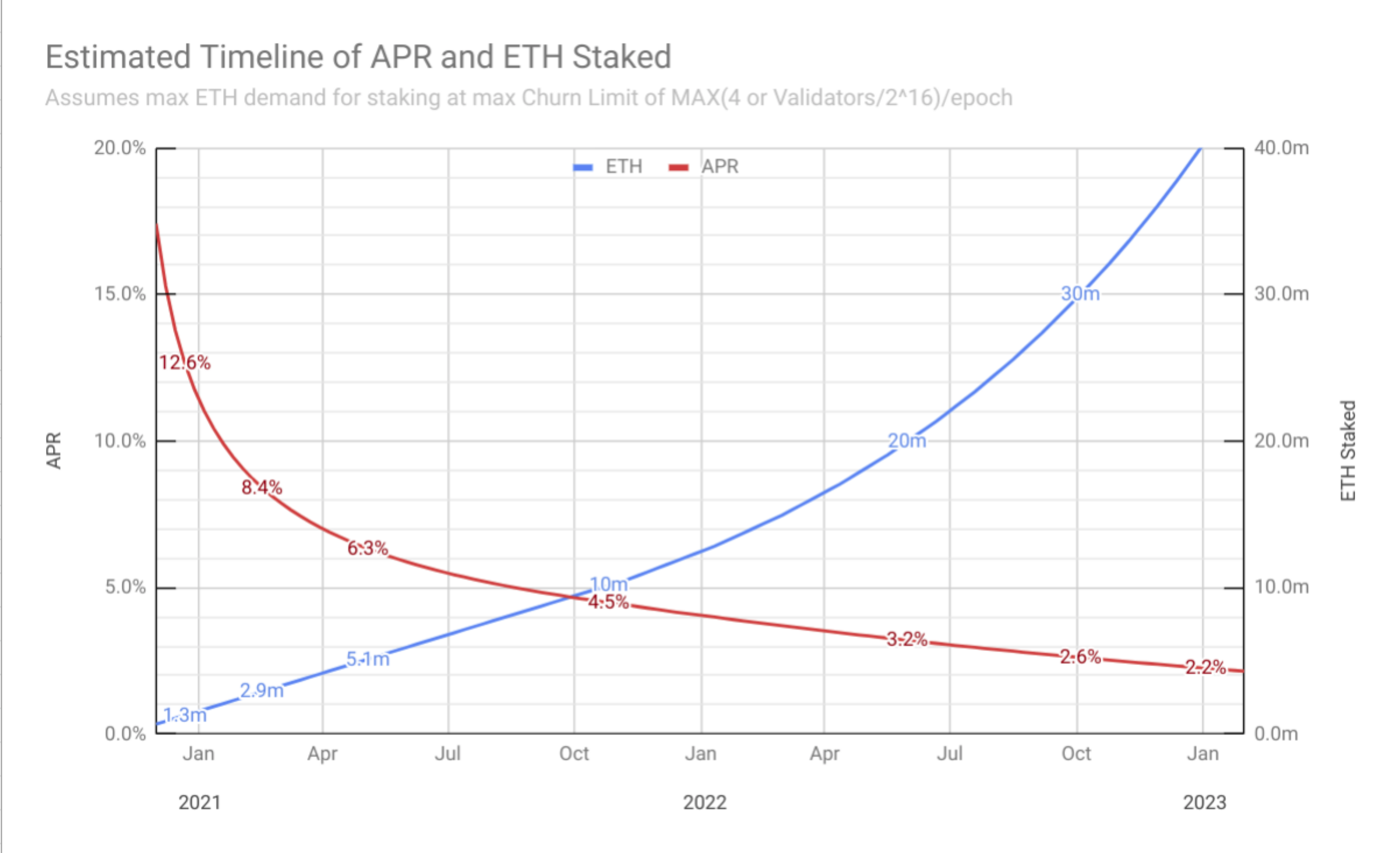
Ethereum Staking APR Timeline Figure 2: Historical and projected Ethereum staking APR vs total ETH staked

Staking Rewards and Economics

Reward Calculation

Ethereum staking rewards come from three sources:

1. Base Rewards (Issuance)

New ETH issued to validators for performing duties:

1
2
3
4
5
6
7
8
9
10
11
12
13
14
15
16
17
18
19
20
21
22
23
24
25
26
27
28
29
30
31
32
33
34
35
36
37
38
39
40
41
42
43
44
45
46
47
48
49
50
import math

def calculate_base_reward_per_epoch(total_active_stake, base_reward_factor=64):
    """
    Calculate base reward per validator per epoch
    
    Formula: (effective_balance * base_reward_factor) / sqrt(total_active_stake)
    
    Args:
        total_active_stake: Total ETH staked (in Gwei)
        base_reward_factor: Protocol constant (64)
    
    Returns:
        Base reward in Gwei
    """
    effective_balance = 32 * 10**9  # 32 ETH in Gwei
    
    base_reward = (effective_balance * base_reward_factor) / math.sqrt(total_active_stake)
    
    return int(base_reward)

def calculate_annual_issuance_rate(total_validators):
    """
    Calculate annual ETH issuance rate
    """
    total_active_stake = total_validators * 32 * 10**9  # Gwei
    
    # Base reward per epoch
    base_reward = calculate_base_reward_per_epoch(total_active_stake)
    
    # Epochs per year
    epochs_per_year = 365.25 * 24 * 60 * 60 / (32 * 12)  # ~82,125
    
    # Annual issuance per validator
    annual_issuance = (base_reward * epochs_per_year) / 10**9  # ETH
    
    # APR
    apr = (annual_issuance / 32) * 100
    
    return apr, annual_issuance

# Calculate for different network sizes
for total_validators in [500_000, 750_000, 1_000_000]:
    total_eth_staked = total_validators * 32
    apr, annual_eth = calculate_annual_issuance_rate(total_validators)
    
    print(f"\nTotal Validators: {total_validators:,}")
    print(f"Total ETH Staked: {total_eth_staked:,} ({total_eth_staked/120_000_000*100:.1f}% of supply)")
    print(f"Base APR: {apr:.2f}%")
    print(f"Annual Issuance per Validator: {annual_eth:.4f} ETH")

Output:

1
2
3
4
5
6
7
8
9
10
11
12
13
14
Total Validators: 500,000
Total ETH Staked: 16,000,000 (13.3% of supply)
Base APR: 5.63%
Annual Issuance per Validator: 1.8016 ETH

Total Validators: 750,000
Total ETH Staked: 24,000,000 (20.0% of supply)
Base APR: 4.60%
Annual Issuance per Validator: 1.4720 ETH

Total Validators: 1,000,000
Total ETH Staked: 32,000,000 (26.7% of supply)
Base APR: 3.98%
Annual Issuance per Validator: 1.2745 ETH

2. Transaction Tips (Priority Fees)

Validators receive tips from users wanting faster inclusion:

1
2
3
4
5
6
7
8
9
10
11
12
13
14
15
16
17
18
19
def calculate_priority_fees(blocks_proposed_per_year=54):
    """
    Calculate expected priority fee earnings
    
    On average, each validator proposes ~54 blocks per year
    """
    # Average priority fee per block (varies widely)
    avg_priority_fee_per_block = 0.05  # ETH (conservative estimate)
    
    annual_priority_fees = blocks_proposed_per_year * avg_priority_fee_per_block
    
    # APR from priority fees
    apr_from_fees = (annual_priority_fees / 32) * 100
    
    return annual_priority_fees, apr_from_fees

priority_eth, priority_apr = calculate_priority_fees()
print(f"Annual Priority Fees: {priority_eth:.4f} ETH")
print(f"APR from Priority Fees: {priority_apr:.2f}%")

3. MEV (Maximal Extractable Value)

Advanced validators can earn MEV through transaction ordering:

1
2
3
4
5
6
7
8
9
10
11
12
13
14
15
16
17
18
19
20
21
22
def calculate_mev_boost_earnings(blocks_per_year=54):
    """
    Calculate MEV-Boost earnings
    
    MEV-Boost connects validators to MEV relay network
    """
    # Average MEV per block (highly variable)
    avg_mev_per_block = 0.08  # ETH
    
    # Not all blocks have MEV opportunities (~70%)
    mev_probability = 0.70
    
    annual_mev = blocks_per_year * avg_mev_per_block * mev_probability
    
    # APR from MEV
    apr_from_mev = (annual_mev / 32) * 100
    
    return annual_mev, apr_from_mev

mev_eth, mev_apr = calculate_mev_boost_earnings()
print(f"Annual MEV Earnings: {mev_eth:.4f} ETH")
print(f"APR from MEV: {mev_apr:.2f}%")

Total Staking Yield

1
2
3
4
5
6
7
8
9
10
11
12
13
14
15
16
17
18
19
20
21
22
23
24
25
26
27
28
29
30
31
32
33
34
35
36
37
38
39
40
41
42
43
44
45
46
47
48
49
50
51
52
53
54
55
56
57
58
59
60
61
62
63
64
65
66
67
68
69
70
71
72
73
74
75
76
77
78
79
80
81
82
83
84
85
86
87
88
class StakingRewardsCalculator:
    """
    Comprehensive staking rewards calculator
    """
    def __init__(self, stake=32, total_validators=900_000):
        self.stake = stake  # ETH
        self.total_validators = total_validators
        
    def calculate_total_apr(self):
        """Calculate total APR from all sources"""
        
        # 1. Base rewards (issuance)
        base_apr, _ = calculate_annual_issuance_rate(self.total_validators)
        
        # 2. Priority fees
        _, priority_apr = calculate_priority_fees()
        
        # 3. MEV
        _, mev_apr = calculate_mev_boost_earnings()
        
        # Total APR
        total_apr = base_apr + priority_apr + mev_apr
        
        # Annual earnings
        annual_earnings = (total_apr / 100) * self.stake
        
        return {
            'base_apr': base_apr,
            'priority_apr': priority_apr,
            'mev_apr': mev_apr,
            'total_apr': total_apr,
            'annual_eth': annual_earnings,
            'monthly_eth': annual_earnings / 12,
            'daily_eth': annual_earnings / 365.25
        }
    
    def compound_growth(self, years=5, compound_frequency='daily'):
        """
        Calculate compound growth with restaking
        """
        rewards = self.calculate_total_apr()
        
        if compound_frequency == 'daily':
            n = 365.25
        elif compound_frequency == 'monthly':
            n = 12
        elif compound_frequency == 'yearly':
            n = 1
        
        # Compound interest formula: A = P(1 + r/n)^(nt)
        r = rewards['total_apr'] / 100
        final_balance = self.stake * (1 + r/n) ** (n * years)
        
        total_earned = final_balance - self.stake
        
        return {
            'initial_stake': self.stake,
            'final_balance': final_balance,
            'total_earned': total_earned,
            'effective_apr': ((final_balance / self.stake) ** (1/years) - 1) * 100
        }

# Example calculations
calculator = StakingRewardsCalculator(stake=32, total_validators=900_000)

# Current rewards
rewards = calculator.calculate_total_apr()
print("📊 STAKING REWARDS BREAKDOWN")
print("=" * 50)
print(f"Base Issuance APR:    {rewards['base_apr']:.2f}%")
print(f"Priority Fees APR:    {rewards['priority_apr']:.2f}%")
print(f"MEV Earnings APR:     {rewards['mev_apr']:.2f}%")
print(f"{''*50}")
print(f"Total APR:            {rewards['total_apr']:.2f}%")
print(f"\n💰 EARNINGS PROJECTIONS")
print(f"{''*50}")
print(f"Daily:   {rewards['daily_eth']:.6f} ETH")
print(f"Monthly: {rewards['monthly_eth']:.6f} ETH")
print(f"Annual:  {rewards['annual_eth']:.4f} ETH")

# 5-year projection with compounding
growth = calculator.compound_growth(years=5, compound_frequency='daily')
print(f"\n📈 5-YEAR PROJECTION (Daily Compounding)")
print(f"{''*50}")
print(f"Initial Stake:   {growth['initial_stake']:.2f} ETH")
print(f"Final Balance:   {growth['final_balance']:.2f} ETH")
print(f"Total Earned:    {growth['total_earned']:.2f} ETH")
print(f"Effective APR:   {growth['effective_apr']:.2f}%")

Factors Affecting Yields

1. Network Participation Rate

More validators = lower individual APR (rewards distributed among more participants)

2. Network Activity

Higher transaction volume = more priority fees and MEV opportunities

3. Validator Performance

  • Uptime: Offline validators miss rewards and incur penalties
  • Attestation Inclusion: Faster attestations earn more
  • Block Proposals: Accurate and timely proposals maximize tips

4. MEV Infrastructure

Using MEV-Boost vs. vanilla block proposals significantly affects earnings

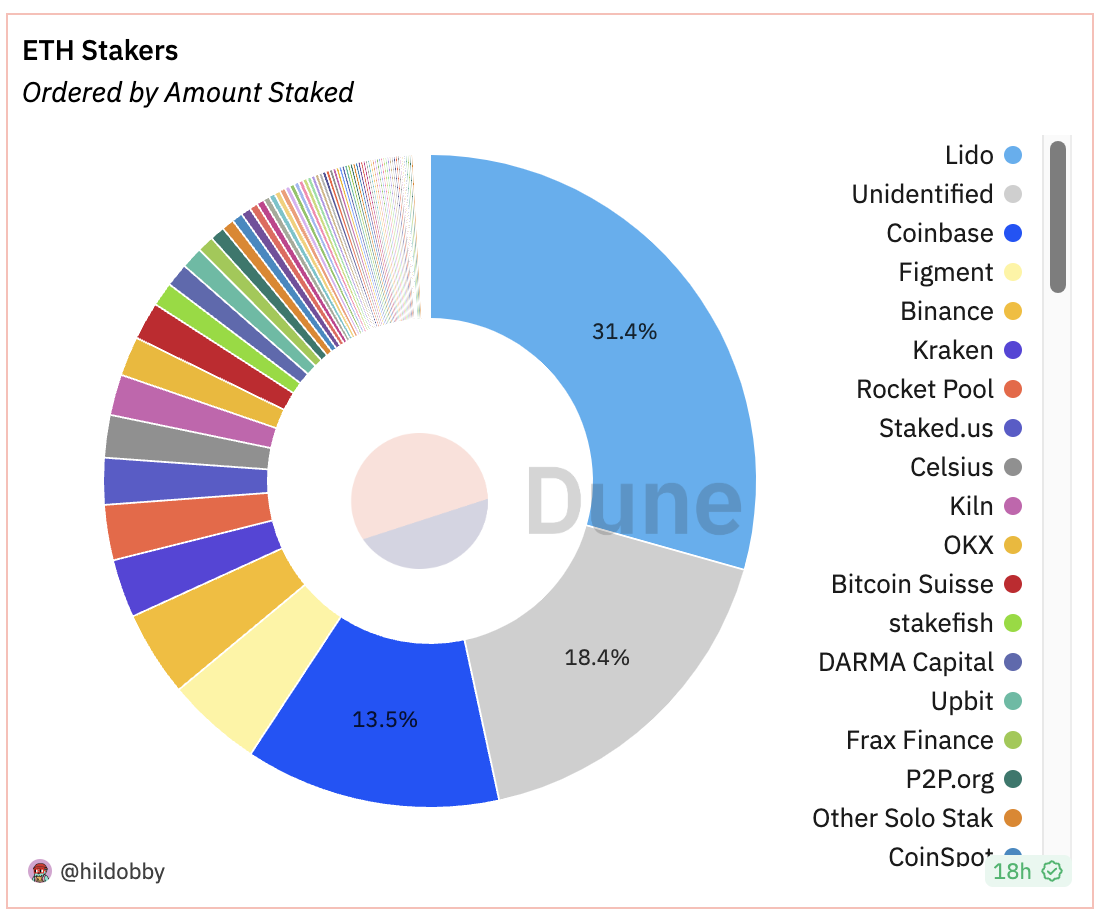
Ethereum Staking Pool Distribution Figure 3: Distribution of staked ETH across different staking pools and entities

Staking Methods Comparison

Solo Staking (Running Your Own Validator)

Requirements:

  • 32 ETH minimum
  • Technical knowledge
  • Hardware and maintenance
  • 24/7 uptime

Advantages: ✅ Full control over setup ✅ Maximum rewards (no pool fees) ✅ Contributes to decentralization ✅ Direct withdrawal control

Disadvantages: ❌ High capital requirement (32 ETH) ❌ Technical complexity ❌ Slashing risk if misconfigured ❌ Hardware and maintenance costs

Best For: Technical users with 32+ ETH wanting maximum control

Pooled Staking (Rocket Pool, Stakewise)

Requirements:

  • As little as 0.01 ETH
  • No technical knowledge
  • Trust in pool operator

Advantages: ✅ Low minimum stake ✅ No technical setup ✅ Professional operation ✅ Some decentralization

Disadvantages: ❌ Pool fees (5-15%) ❌ Trust in third party ❌ Less control ❌ Potential smart contract risks

Best For: Users with less than 32 ETH or non-technical users

Example: Rocket Pool

1
2
3
4
5
6
7
8
9
10
11
12
13
14
15
16
17
18
19
20
21
22
23
24
25
26
27
28
29
30
31
32
33
34
35
36
37
38
39
40
41
42
43
44
45
46
47
48
49
from web3 import Web3

class RocketPoolStaker:
    """
    Interact with Rocket Pool liquid staking protocol
    """
    def __init__(self, w3, deposit_pool_address):
        self.w3 = w3
        self.deposit_pool = self.w3.eth.contract(
            address=deposit_pool_address,
            abi=ROCKET_POOL_ABI
        )
    
    def stake_eth(self, amount_eth, from_address, private_key):
        """
        Stake ETH and receive rETH (Rocket Pool ETH)
        """
        amount_wei = self.w3.to_wei(amount_eth, 'ether')
        
        # Get current rETH exchange rate
        rate = self.deposit_pool.functions.getExchangeRate().call()
        expected_reth = amount_wei * rate / 10**18
        
        # Create deposit transaction
        tx = self.deposit_pool.functions.deposit().build_transaction({
            'from': from_address,
            'value': amount_wei,
            'gas': 200000,
            'gasPrice': self.w3.eth.gas_price,
            'nonce': self.w3.eth.get_transaction_count(from_address)
        })
        
        # Sign and send
        signed = self.w3.eth.account.sign_transaction(tx, private_key)
        tx_hash = self.w3.eth.send_raw_transaction(signed.rawTransaction)
        
        print(f"Staked {amount_eth} ETH")
        print(f"Expected rETH: {expected_reth / 10**18:.6f}")
        print(f"Transaction: {tx_hash.hex()}")
        
        return tx_hash
    
    def get_reth_value(self, reth_amount):
        """
        Calculate current ETH value of rETH tokens
        """
        rate = self.deposit_pool.functions.getExchangeRate().call()
        eth_value = (reth_amount * rate) / 10**18
        return eth_value

Liquid Staking (Lido, Frax)

Requirements:

  • Any amount of ETH
  • No technical knowledge
  • Receive liquid staking token

Advantages: ✅ Stake any amount ✅ Receive tradeable token (stETH, frxETH) ✅ Use staked ETH in DeFi ✅ Instant liquidity

Disadvantages: ❌ Centralization risk (Lido has ~30% of staked ETH) ❌ Smart contract risk ❌ Depeg risk (token value diverge from ETH) ❌ Fee (typically 10%)

Best For: Users wanting liquidity and DeFi composability

Example: Lido stETH

1
2
3
4
5
6
7
8
9
10
11
12
13
14
15
16
17
18
19
20
21
22
23
24
25
26
27
28
29
30
31
32
33
34
35
36
37
38
39
40
41
42
43
44
45
46
47
48
49
50
51
52
53
class LidoStaker:
    """
    Stake ETH with Lido and receive stETH
    """
    def __init__(self, w3, lido_address):
        self.w3 = w3
        self.lido = self.w3.eth.contract(
            address=lido_address,
            abi=LIDO_ABI
        )
    
    def stake_eth(self, amount_eth, from_address, private_key):
        """
        Stake ETH and receive stETH (1:1 initially)
        stETH balance grows via daily rebases
        """
        amount_wei = self.w3.to_wei(amount_eth, 'ether')
        
        # Submit ETH to Lido
        tx = self.lido.functions.submit(
            '0x0000000000000000000000000000000000000000'  # Referral address
        ).build_transaction({
            'from': from_address,
            'value': amount_wei,
            'gas': 150000,
            'gasPrice': self.w3.eth.gas_price,
            'nonce': self.w3.eth.get_transaction_count(from_address)
        })
        
        signed = self.w3.eth.account.sign_transaction(tx, private_key)
        tx_hash = self.w3.eth.send_raw_transaction(signed.rawTransaction)
        
        print(f"Staked {amount_eth} ETH with Lido")
        print(f"Received ~{amount_eth} stETH")
        print(f"Transaction: {tx_hash.hex()}")
        
        return tx_hash
    
    def get_steth_balance(self, address):
        """Get stETH balance (increases via rebases)"""
        balance_wei = self.lido.functions.balanceOf(address).call()
        return self.w3.from_wei(balance_wei, 'ether')
    
    def calculate_rewards(self, initial_steth, current_steth):
        """Calculate accumulated staking rewards"""
        rewards = current_steth - initial_steth
        apr = (rewards / initial_steth) * 100  # Annualized if 1 year
        
        return {
            'rewards_eth': rewards,
            'apr': apr,
            'total_value': current_steth
        }

Exchange Staking (Coinbase, Kraken, Binance)

Requirements:

  • Account on exchange
  • Minimal technical knowledge
  • Any amount of ETH

Advantages: ✅ Easiest option ✅ No setup required ✅ Customer support ✅ Insured (some exchanges)

Disadvantages: ❌ Not your keys, not your coins ❌ Highest fees (15-25%) ❌ Centralization ❌ Withdrawal limits ❌ Regulatory risk

Best For: Complete beginners, small amounts

Staking Comparison Table

MethodMin. StakeAPRTechnical LevelLiquidityDecentralization
Solo32 ETH4-7%HighLockedHighest
Pooled0.01 ETH3-6%LowLockedMedium
LiquidAny3-5%NoneInstantLow
ExchangeAny2-4%NoneLimitedLowest

Risks and Penalties

Slashing Conditions

Slashing is an automatic penalty for malicious behavior:

1. Double Attestation

  • Signing two different attestations for same slot
  • Penalty: Minimum 1 ETH, up to entire stake

2. Surround Vote

  • Creating contradiction in attestation history
  • Penalty: Proportional to violation severity

3. Double Block Proposal

  • Proposing two blocks for same slot
  • Penalty: Severe, potential full stake loss
1
2
3
4
5
6
7
8
9
10
11
12
13
14
15
16
17
18
19
20
21
22
23
24
25
26
27
28
29
30
31
32
33
34
35
36
37
38
39
40
41
42
43
44
45
46
47
48
49
50
51
52
53
54
55
56
57
58
59
60
61
62
63
64
65
66
class SlashingMonitor:
    """
    Monitor for potential slashing events
    """
    def __init__(self, validator_index):
        self.validator_index = validator_index
        self.attestations_cache = {}
        self.proposed_blocks = set()
    
    def check_double_attestation(self, attestation):
        """
        Check if attestation conflicts with previous
        """
        key = (attestation['slot'], attestation['committee_index'])
        
        if key in self.attestations_cache:
            previous = self.attestations_cache[key]
            
            if (previous['beacon_block_root'] != attestation['beacon_block_root'] or
                previous['target'] != attestation['target']):
                
                return {
                    'slashable': True,
                    'type': 'double_attestation',
                    'severity': 'high',
                    'penalty_eth': 1.0  # Minimum penalty
                }
        
        self.attestations_cache[key] = attestation
        return {'slashable': False}
    
    def check_double_proposal(self, block):
        """
        Check if block conflicts with previous proposal
        """
        key = block['slot']
        
        if key in self.proposed_blocks:
            return {
                'slashable': True,
                'type': 'double_proposal',
                'severity': 'critical',
                'penalty_eth': 32.0  # Potential full stake loss
            }
        
        self.proposed_blocks.add(key)
        return {'slashable': False}
    
    def estimate_slashing_penalty(self, validator_effective_balance, total_slashed_balance):
        """
        Calculate proportional slashing penalty
        
        Penalty increases with more validators slashed simultaneously
        """
        # Base penalty
        penalty = validator_effective_balance / 32
        
        # Proportional penalty (correlates with attack severity)
        proportional_penalty = (
            validator_effective_balance * 
            min(total_slashed_balance * 3, validator_effective_balance)
        ) / validator_effective_balance
        
        total_penalty = penalty + proportional_penalty
        
        return min(total_penalty, validator_effective_balance)

Inactivity Penalties

Validators that are offline lose rewards and incur penalties:

1
2
3
4
5
6
7
8
9
10
11
12
13
14
15
16
17
18
19
20
21
22
23
24
25
26
27
28
29
30
31
def calculate_inactivity_penalty(offline_epochs, effective_balance=32):
    """
    Calculate penalty for being offline
    
    Penalties increase quadratically during inactivity leak
    """
    # During normal operation
    if offline_epochs < 4:  # < ~25 minutes
        # Miss rewards only, no penalty
        missed_rewards = effective_balance * 0.0001 * offline_epochs
        return missed_rewards, 'rewards_only'
    
    # During inactivity leak (network not finalizing)
    else:
        # Quadratic penalty
        base_penalty_rate = 0.0001
        inactivity_penalty_rate = base_penalty_rate * (offline_epochs ** 2)
        
        total_penalty = effective_balance * inactivity_penalty_rate
        
        return total_penalty, 'inactivity_leak'

# Examples
for days_offline in [0.01, 1, 7, 30]:
    epochs = days_offline * 225  # ~225 epochs per day
    penalty, leak_type = calculate_inactivity_penalty(epochs)
    
    print(f"\n⚠️ Offline for {days_offline} days:")
    print(f"   Epochs missed: {int(epochs)}")
    print(f"   Penalty: {penalty:.4f} ETH")
    print(f"   Type: {leak_type}")

Best Practices to Avoid Penalties

1. Redundancy

1
2
3
4
5
6
7
8
9
10
# Use failover setup with secondary beacon node
# Primary node monitoring
while true; do
    if ! systemctl is-active --quiet lighthouse-beacon; then
        # Switch to backup node
        lighthouse vc --beacon-nodes \
            http://backup-node-1:5052,http://backup-node-2:5052
    fi
    sleep 30
done

2. Slashing Protection

1
2
3
4
5
6
7
8
9
10
11
12
13
14
15
16
17
18
19
20
21
22
23
24
25
26
27
28
29
30
31
32
33
34
35
36
37
38
39
40
41
42
43
44
45
46
# Enable slashing protection database
class SlashingProtection:
    """
    Database to prevent double signing
    """
    def __init__(self, db_path):
        self.db = sqlite3.connect(db_path)
        self.init_db()
    
    def init_db(self):
        self.db.execute('''
            CREATE TABLE IF NOT EXISTS signed_attestations (
                validator_index INTEGER,
                source_epoch INTEGER,
                target_epoch INTEGER,
                signing_root TEXT,
                UNIQUE(validator_index, target_epoch)
            )
        ''')
        
        self.db.execute('''
            CREATE TABLE IF NOT EXISTS signed_blocks (
                validator_index INTEGER,
                slot INTEGER,
                signing_root TEXT,
                UNIQUE(validator_index, slot)
            )
        ''')
    
    def check_and_record_attestation(self, validator_index, attestation):
        """Prevent double attestation"""
        cursor = self.db.execute('''
            SELECT * FROM signed_attestations 
            WHERE validator_index = ? AND target_epoch = ?
        ''', (validator_index, attestation['target_epoch']))
        
        if cursor.fetchone():
            raise Exception("⛔ SLASHING RISK: Already signed attestation for this epoch!")
        
        # Record this attestation
        self.db.execute('''
            INSERT INTO signed_attestations VALUES (?, ?, ?, ?)
        ''', (validator_index, attestation['source_epoch'], 
              attestation['target_epoch'], attestation['signing_root']))
        
        self.db.commit()

3. Monitoring and Alerts

1
2
3
4
5
6
7
8
9
10
11
12
13
14
15
16
17
18
19
20
21
22
23
24
25
26
27
28
29
30
31
32
33
34
35
36
37
38
39
40
41
42
43
44
45
46
47
48
49
50
51
52
53
54
55
56
57
58
59
60
61
62
63
64
65
66
67
68
69
70
71
72
73
74
75
76
77
78
79
80
81
82
83
84
85
86
87
88
89
90
91
92
93
94
95
96
97
98
99
100
101
102
103
104
105
import requests
from datetime import datetime, timedelta

class ValidatorMonitor:
    """
    Monitor validator performance and send alerts
    """
    def __init__(self, validator_index, beacon_node_url):
        self.validator_index = validator_index
        self.beacon_url = beacon_node_url
        
    def check_validator_status(self):
        """Get current validator status"""
        response = requests.get(
            f"{self.beacon_url}/eth/v1/beacon/states/head/validators/{self.validator_index}"
        )
        
        data = response.json()['data']
        
        return {
            'balance': int(data['balance']) / 10**9,  # Gwei to ETH
            'effective_balance': int(data['validator']['effective_balance']) / 10**9,
            'slashed': data['validator']['slashed'],
            'activation_epoch': int(data['validator']['activation_epoch']),
            'status': data['status']
        }
    
    def check_recent_performance(self, epochs=10):
        """Check attestation performance"""
        head_epoch = self.get_current_epoch()
        
        total_duties = 0
        completed_duties = 0
        
        for epoch in range(head_epoch - epochs, head_epoch):
            duties = self.get_epoch_duties(epoch)
            total_duties += len(duties)
            
            for duty in duties:
                if self.check_duty_completed(duty):
                    completed_duties += 1
        
        performance = (completed_duties / total_duties * 100) if total_duties > 0 else 0
        
        return {
            'total_duties': total_duties,
            'completed': completed_duties,
            'performance': performance
        }
    
    def send_alert(self, message, severity='info'):
        """Send alert (email, Telegram, Discord, etc.)"""
        # Example: Telegram bot
        telegram_bot_token = 'YOUR_BOT_TOKEN'
        telegram_chat_id = 'YOUR_CHAT_ID'
        
        emoji = {'info': 'ℹ️', 'warning': '⚠️', 'critical': '🚨'}
        
        message = f"{emoji.get(severity, 'ℹ️')} **Validator Alert**\n\n{message}"
        
        requests.post(
            f'https://api.telegram.org/bot{telegram_bot_token}/sendMessage',
            json={'chat_id': telegram_chat_id, 'text': message, 'parse_mode': 'Markdown'}
        )
    
    def monitor_loop(self):
        """Continuous monitoring"""
        while True:
            try:
                # Check status
                status = self.check_validator_status()
                
                # Alert if slashed
                if status['slashed']:
                    self.send_alert(
                        f"Validator {self.validator_index} has been SLASHED!",
                        severity='critical'
                    )
                
                # Check performance
                performance = self.check_recent_performance()
                
                if performance['performance'] < 95:
                    self.send_alert(
                        f"Low performance: {performance['performance']:.1f}% "
                        f"({performance['completed']}/{performance['total_duties']} duties)",
                        severity='warning'
                    )
                
                # Check balance decrease
                if status['balance'] < status['effective_balance'] * 0.95:
                    self.send_alert(
                        f"Balance decreased significantly: {status['balance']:.4f} ETH",
                        severity='warning'
                    )
                
                time.sleep(300)  # Check every 5 minutes
                
            except Exception as e:
                self.send_alert(f"Monitoring error: {e}", severity='warning')
                time.sleep(60)

# Run monitor
monitor = ValidatorMonitor(validator_index=123456, beacon_node_url='http://localhost:5052')
monitor.monitor_loop()

Tax Implications

Staking rewards have tax implications in most jurisdictions:

General Principles:

  • Rewards are typically taxable as income when received
  • Cost basis for rewards is fair market value at receipt
  • Selling/trading staked ETH triggers capital gains tax
  • Penalties and slashing may be deductible losses
1
2
3
4
5
6
7
8
9
10
11
12
13
14
15
16
17
18
19
20
21
22
23
24
25
26
27
28
29
30
31
32
33
34
35
36
37
38
39
40
41
42
43
44
45
46
47
48
49
50
51
52
53
54
55
56
57
58
59
60
61
62
63
64
65
66
67
68
69
70
71
72
73
74
75
76
77
78
79
from datetime import datetime

class StakingTaxTracker:
    """
    Track staking rewards for tax reporting
    """
    def __init__(self, tax_year):
        self.tax_year = tax_year
        self.rewards = []
        
    def record_reward(self, date, amount_eth, price_usd):
        """
        Record staking reward receipt
        """
        reward = {
            'date': date,
            'amount_eth': amount_eth,
            'price_usd': price_usd,
            'value_usd': amount_eth * price_usd,
            'cost_basis': amount_eth * price_usd  # For future capital gains
        }
        
        self.rewards.append(reward)
        
        return reward
    
    def generate_tax_report(self):
        """
        Generate annual tax report
        """
        total_eth = sum(r['amount_eth'] for r in self.rewards)
        total_value = sum(r['value_usd'] for r in self.rewards)
        
        # Group by month
        monthly = {}
        for reward in self.rewards:
            month = reward['date'].strftime('%Y-%m')
            if month not in monthly:
                monthly[month] = {'eth': 0, 'usd': 0}
            
            monthly[month]['eth'] += reward['amount_eth']
            monthly[month]['usd'] += reward['value_usd']
        
        report = {
            'tax_year': self.tax_year,
            'total_rewards_eth': total_eth,
            'total_income_usd': total_value,
            'number_of_rewards': len(self.rewards),
            'monthly_breakdown': monthly,
            'rewards_detail': self.rewards
        }
        
        return report
    
    def export_csv(self, filename):
        """Export to CSV for tax software"""
        import csv
        
        with open(filename, 'w', newline='') as f:
            writer = csv.DictWriter(f, fieldnames=['date', 'amount_eth', 'price_usd', 'value_usd'])
            writer.writeheader()
            writer.writerows(self.rewards)

# Example usage
tracker = StakingTaxTracker(tax_year=2024)

# Record daily rewards
tracker.record_reward(
    date=datetime(2024, 1, 15),
    amount_eth=0.0045,
    price_usd=2350.00
)

# Generate annual report
report = tracker.generate_tax_report()
print(f"Total Income: ${report['total_income_usd']:,.2f}")

# Export for CPA
tracker.export_csv('staking_rewards_2024.csv')

Conclusion

Ethereum staking represents a fundamental shift in how the network achieves consensus and distributes rewards. Whether you’re running your own validator with 32 ETH or participating through liquid staking protocols with any amount, understanding the technical requirements, economic incentives, and risk factors is crucial for success.

Key Takeaways

  1. Multiple Paths: Choose the staking method that matches your technical ability and capital
  2. Rewards: Expect 3-7% APR from combined issuance, tips, and MEV
  3. Risks: Slashing and inactivity penalties are real but avoidable with proper setup
  4. Decentralization Matters: Solo staking contributes most to network security
  5. Tax Implications: Track rewards carefully for tax reporting

Getting Started

If you have 32+ ETH and technical skills:

  • Solo staking provides maximum rewards and contributes to decentralization
  • Budget for hardware (~$2000) and consider redundancy

If you have less than 32 ETH:

  • Rocket Pool or Stakewise for pooled staking
  • Lido or Frax if you need liquidity

If you’re non-technical:

  • Start with liquid staking (Lido) or exchange staking
  • Learn and potentially migrate to more decentralized options

Resources

The future of Ethereum is secured by its stakers. Whether you’re earning passive income or contributing to network decentralization, staking plays a vital role in the Ethereum ecosystem. Start your staking journey with proper research, robust infrastructure, and a long-term perspective.

Happy staking! 🚀🔒

Bu gönderi CC BY 4.0 lisansı altındadır.