Giriş
Modern yazılım geliştirmede performans ve ölçeklenebilirlik kritik önem taşır. Python’un asyncio modülü, tek bir thread içinde binlerce eşzamanlı işlemi yönetebilme yeteneği sağlar. Bu rehberde, asyncio ile asenkron programlamanın temellerinden ileri seviye tekniklerine kadar tüm detayları öğreneceksiniz.
Asyncio, I/O-bound işlemlerde (network istekleri, dosya okuma/yazma, veritabanı sorguları) CPU’yu boşta bekletmek yerine diğer görevlere geçiş yaparak maksimum verimlilik sağlar.
Senkron vs Asenkron Programlama
Senkron Yaklaşım
1
2
3
4
5
6
7
8
9
10
11
12
13
14
15
16
17
18
19
20
21
22
23
24
25
26
27
28
29
30
31
32
| import time
import requests
def fetch_data(url):
"""Senkron HTTP isteği"""
response = requests.get(url)
return response.json()
def main():
urls = [
'https://api.github.com/users/python',
'https://api.github.com/users/django',
'https://api.github.com/users/flask',
'https://api.github.com/users/fastapi',
]
start = time.time()
results = []
for url in urls:
# Her istek diğerini bekler (blocking)
data = fetch_data(url)
results.append(data)
elapsed = time.time() - start
print(f"Toplam süre: {elapsed:.2f} saniye")
# Çıktı: ~4-6 saniye (her istek ~1-1.5 saniye)
return results
if __name__ == "__main__":
main()
|
1
2
3
4
5
6
7
8
9
10
11
12
13
14
15
16
17
18
19
20
21
22
23
24
25
26
27
28
29
30
31
32
33
34
35
36
|
### Asenkron Yaklaşım
```python
import asyncio
import aiohttp
import time
async def fetch_data(session, url):
"""Asenkron HTTP isteği"""
async with session.get(url) as response:
return await response.json()
async def main():
urls = [
'https://api.github.com/users/python',
'https://api.github.com/users/django',
'https://api.github.com/users/flask',
'https://api.github.com/users/fastapi',
]
start = time.time()
async with aiohttp.ClientSession() as session:
# Tüm istekler eşzamanlı çalışır
tasks = [fetch_data(session, url) for url in urls]
results = await asyncio.gather(*tasks)
elapsed = time.time() - start
print(f"Toplam süre: {elapsed:.2f} saniye")
# Çıktı: ~1-1.5 saniye (paralel çalışma)
return results
if __name__ == "__main__":
asyncio.run(main())
|
1
2
3
4
5
6
7
8
9
10
11
12
13
14
15
16
17
18
19
20
21
22
23
24
25
26
27
|
{: w="700" h="400" .shadow }
_Asenkron ve senkron işlemlerin karşılaştırmalı görselleştirmesi_
## Event Loop Nedir?
Event loop, asyncio'nun kalbidir. Tüm asenkron görevleri yönetir, bekleyen I/O işlemlerini takip eder ve hazır olan görevleri çalıştırır.
### Event Loop Temel Kavramları
```python
import asyncio
# Event loop'a manuel erişim
loop = asyncio.get_event_loop()
# Python 3.7+ ile önerilen yöntem
asyncio.run(main()) # Otomatik loop yönetimi
# Event loop bilgisi
def show_loop_info():
loop = asyncio.get_running_loop()
print(f"Loop running: {loop.is_running()}")
print(f"Loop closed: {loop.is_closed()}")
print(f"Debug mode: {loop.get_debug()}")
asyncio.run(show_loop_info())
|
1
2
3
4
5
6
7
8
9
10
11
12
13
14
15
16
17
18
19
20
21
22
23
24
25
26
27
28
29
30
31
32
33
34
35
36
37
|
### Event Loop Yaşam Döngüsü
```python
import asyncio
async def task1():
print("Task 1: Başladı")
await asyncio.sleep(1) # I/O simülasyonu
print("Task 1: Tamamlandı")
return "Sonuç 1"
async def task2():
print("Task 2: Başladı")
await asyncio.sleep(0.5)
print("Task 2: Tamamlandı")
return "Sonuç 2"
async def main():
print("Main başladı")
# Event loop bu görevleri yönetir
result1, result2 = await asyncio.gather(task1(), task2())
print(f"Sonuçlar: {result1}, {result2}")
print("Main tamamlandı")
# Çıktı:
# Main başladı
# Task 1: Başladı
# Task 2: Başladı
# Task 2: Tamamlandı
# Task 1: Tamamlandı
# Sonuçlar: Sonuç 1, Sonuç 2
# Main tamamlandı
asyncio.run(main())
|
Coroutines (Eş Yordamlar)
Coroutine, duraklatılıp devam ettirilebilen fonksiyonlardır. async def ile tanımlanır ve await ile çağrılır.
Coroutine Tanımlama
1
2
3
4
5
6
7
8
9
10
11
12
| import asyncio
# Basit coroutine
async def hello_world():
print("Hello")
await asyncio.sleep(1) # Event loop'a kontrol verir
print("World")
return "Tamamlandı"
# Coroutine çalıştırma
result = asyncio.run(hello_world())
print(result) # "Tamamlandı"
|
1
2
3
4
5
6
7
8
9
10
11
12
13
14
15
16
17
18
19
20
21
22
23
24
25
26
27
28
29
30
31
32
33
34
35
|
### Coroutine Zincirleme
```python
import asyncio
async def fetch_user(user_id):
"""Kullanıcı bilgisi getir"""
print(f"Fetching user {user_id}...")
await asyncio.sleep(1) # API call simülasyonu
return {"id": user_id, "name": f"User {user_id}"}
async def fetch_user_posts(user_id):
"""Kullanıcı postlarını getir"""
print(f"Fetching posts for user {user_id}...")
await asyncio.sleep(0.5)
return [
{"id": 1, "title": "Post 1"},
{"id": 2, "title": "Post 2"}
]
async def get_user_data(user_id):
"""Kullanıcı ve postlarını birlikte getir"""
# Sıralı çalışma
user = await fetch_user(user_id)
posts = await fetch_user_posts(user_id)
user['posts'] = posts
return user
async def main():
user_data = await get_user_data(123)
print(f"User: {user_data}")
asyncio.run(main())
|
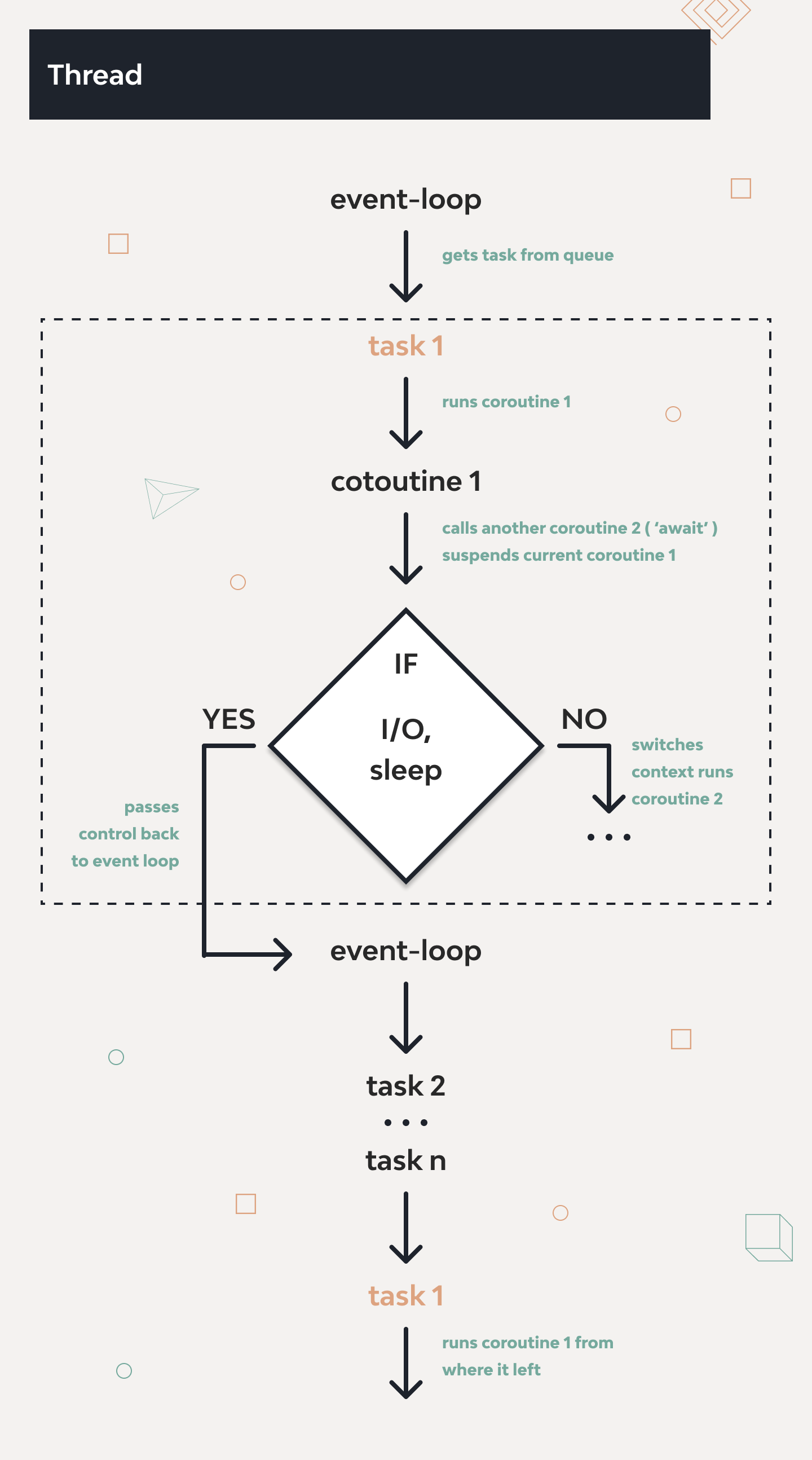
Python coroutine çalışma akışı diyagramı
Paralel Coroutine Çalıştırma
1
2
3
4
5
6
7
8
9
10
11
12
13
14
15
16
17
18
19
20
21
22
23
24
25
26
27
| import asyncio
async def get_user_data_parallel(user_id):
"""Kullanıcı ve postlarını paralel getir"""
# asyncio.gather ile paralel çalışma
user, posts = await asyncio.gather(
fetch_user(user_id),
fetch_user_posts(user_id)
)
user['posts'] = posts
return user
async def main():
# Tek kullanıcı - paralel data fetching
start = time.time()
user_data = await get_user_data_parallel(123)
print(f"Süre: {time.time() - start:.2f}s") # ~1s (paralel)
# Çok kullanıcı - tümü paralel
start = time.time()
users = await asyncio.gather(*[
get_user_data_parallel(i) for i in range(1, 6)
])
print(f"5 kullanıcı süresi: {time.time() - start:.2f}s") # ~1s
asyncio.run(main())
|
async/await Syntax
await Kullanımı
1
2
3
4
5
6
7
8
9
10
11
12
13
14
15
16
17
18
19
20
21
22
23
24
25
26
27
| import asyncio
async def cpu_bound_work():
"""CPU-bound işlem (async'e uygun değil!)"""
total = sum(i * i for i in range(10**7))
return total
async def io_bound_work():
"""I/O-bound işlem (async'e uygun)"""
await asyncio.sleep(1) # Network/disk I/O
return "Completed"
async def main():
# ❌ Yanlış: CPU-bound işlemde await gereksiz
result1 = await cpu_bound_work()
# ✅ Doğru: I/O-bound işlemde await gerekli
result2 = await io_bound_work()
# ✅ Doğru: Paralel I/O işlemleri
results = await asyncio.gather(
io_bound_work(),
io_bound_work(),
io_bound_work()
)
asyncio.run(main())
|
Await Olmadan Coroutine
1
2
3
4
5
6
7
8
9
10
11
12
13
14
15
16
17
| import asyncio
async def my_coroutine():
await asyncio.sleep(1)
return "Result"
async def main():
# ❌ Yanlış: await yok - coroutine çalışmaz
coro = my_coroutine()
print(coro) # <coroutine object my_coroutine at 0x...>
# RuntimeWarning: coroutine 'my_coroutine' was never awaited
# ✅ Doğru: await ile çalıştır
result = await my_coroutine()
print(result) # "Result"
asyncio.run(main())
|
Tasks ve Task Yönetimi
Task, event loop tarafından zamanlanmış bir coroutine wrapper’ıdır.
Task Oluşturma
1
2
3
4
5
6
7
8
9
10
11
12
13
14
15
16
17
18
19
20
21
22
23
24
25
| import asyncio
async def background_task(name, delay):
"""Arka plan görevi"""
print(f"{name} başladı")
await asyncio.sleep(delay)
print(f"{name} tamamlandı")
return f"{name} sonucu"
async def main():
# Task oluşturma
task1 = asyncio.create_task(background_task("Task-1", 2))
task2 = asyncio.create_task(background_task("Task-2", 1))
print("Tasks oluşturuldu, ana iş devam ediyor...")
await asyncio.sleep(0.5)
print("Ana iş tamamlandı")
# Task sonuçlarını bekle
result1 = await task1
result2 = await task2
print(f"Sonuçlar: {result1}, {result2}")
asyncio.run(main())
|
1
2
3
4
5
6
7
8
9
10
11
12
13
14
15
16
17
18
19
20
21
22
23
24
25
26
27
28
29
30
31
32
33
|
{: w="700" h="400" .shadow }
_Asyncio task queue işleme süreci_
### Task İptali
```python
import asyncio
async def long_running_task():
"""Uzun süren görev"""
try:
print("Task başladı")
await asyncio.sleep(10)
print("Task tamamlandı")
except asyncio.CancelledError:
print("Task iptal edildi!")
raise # Exception'ı yeniden fırlat
async def main():
task = asyncio.create_task(long_running_task())
await asyncio.sleep(2)
# Task'ı iptal et
task.cancel()
try:
await task
except asyncio.CancelledError:
print("Main: Task iptal edildiğini bildirdi")
asyncio.run(main())
|
Task Durumu Kontrolü
1
2
3
4
5
6
7
8
9
10
11
12
13
14
15
16
17
18
19
20
21
| import asyncio
async def monitored_task(delay):
await asyncio.sleep(delay)
return f"Completed after {delay}s"
async def main():
task = asyncio.create_task(monitored_task(2))
# Task durumu
print(f"Done: {task.done()}") # False
print(f"Cancelled: {task.cancelled()}") # False
await asyncio.sleep(0.5)
print(f"Still running, done: {task.done()}") # False
result = await task
print(f"Done: {task.done()}") # True
print(f"Result: {task.result()}") # "Completed after 2s"
asyncio.run(main())
|
asyncio.gather vs asyncio.wait
asyncio.gather
1
2
3
4
5
6
7
8
9
10
11
12
13
14
15
16
17
18
19
20
21
| import asyncio
import random
async def fetch_data(source):
delay = random.uniform(0.5, 2.0)
await asyncio.sleep(delay)
return f"Data from {source}"
async def main_gather():
# gather: Tüm sonuçları liste olarak döner
results = await asyncio.gather(
fetch_data("API-1"),
fetch_data("API-2"),
fetch_data("API-3"),
return_exceptions=True # Exception yakalama
)
print("Gather results:", results)
# ['Data from API-1', 'Data from API-2', 'Data from API-3']
asyncio.run(main_gather())
|
1
2
3
4
5
6
7
8
9
10
11
12
13
14
15
16
17
18
19
20
21
22
23
24
25
26
27
28
29
30
|
### asyncio.wait
```python
import asyncio
async def main_wait():
tasks = [
asyncio.create_task(fetch_data("API-1")),
asyncio.create_task(fetch_data("API-2")),
asyncio.create_task(fetch_data("API-3")),
]
# wait: done ve pending setleri döner
done, pending = await asyncio.wait(
tasks,
return_when=asyncio.FIRST_COMPLETED
)
print(f"Tamamlanan: {len(done)}")
print(f"Bekleyen: {len(pending)}")
for task in done:
print(f"Result: {task.result()}")
# Kalan görevleri iptal et
for task in pending:
task.cancel()
asyncio.run(main_wait())
|
1
2
3
4
5
6
7
8
9
10
11
12
13
14
15
16
17
18
19
20
21
22
23
24
25
26
27
28
29
30
31
32
33
34
35
36
37
38
39
40
41
42
43
44
45
46
47
48
49
50
51
52
53
54
55
56
57
|
### gather vs wait Karşılaştırma
```python
import asyncio
import time
async def task_with_timeout(name, duration):
await asyncio.sleep(duration)
return f"{name} completed"
async def compare_gather_wait():
# gather: Basit, sonuç listesi
print("=== GATHER ===")
start = time.time()
results = await asyncio.gather(
task_with_timeout("T1", 1),
task_with_timeout("T2", 2),
task_with_timeout("T3", 1.5)
)
print(f"Gather sonuçları: {results}")
print(f"Süre: {time.time() - start:.2f}s\n")
# wait: Esnek, done/pending kontrolü
print("=== WAIT (ALL_COMPLETED) ===")
start = time.time()
tasks = [
asyncio.create_task(task_with_timeout("T1", 1)),
asyncio.create_task(task_with_timeout("T2", 2)),
asyncio.create_task(task_with_timeout("T3", 1.5))
]
done, pending = await asyncio.wait(tasks)
results = [task.result() for task in done]
print(f"Wait sonuçları: {results}")
print(f"Süre: {time.time() - start:.2f}s\n")
# wait: İlk tamamlanana kadar bekle
print("=== WAIT (FIRST_COMPLETED) ===")
start = time.time()
tasks = [
asyncio.create_task(task_with_timeout("T1", 1)),
asyncio.create_task(task_with_timeout("T2", 2)),
asyncio.create_task(task_with_timeout("T3", 1.5))
]
done, pending = await asyncio.wait(
tasks,
return_when=asyncio.FIRST_COMPLETED
)
first_result = list(done)[0].result()
print(f"İlk sonuç: {first_result}")
print(f"Süre: {time.time() - start:.2f}s")
# Kalan görevleri iptal et
for task in pending:
task.cancel()
asyncio.run(compare_gather_wait())
|
asyncio.gather() basit paralel işlemler için, asyncio.wait() ise esnek kontrol gereken durumlar için uygundur.
1
2
3
4
5
6
7
8
9
10
11
12
13
14
15
16
17
18
19
20
21
22
23
24
25
|
## Timeout İşlemleri
### asyncio.wait_for
```python
import asyncio
async def slow_operation():
"""Yavaş işlem"""
await asyncio.sleep(5)
return "Completed"
async def main():
try:
# 2 saniye timeout
result = await asyncio.wait_for(
slow_operation(),
timeout=2.0
)
print(result)
except asyncio.TimeoutError:
print("İşlem zaman aşımına uğradı!")
asyncio.run(main())
|
1
2
3
4
5
6
7
8
9
10
11
12
13
14
15
16
17
18
19
20
21
|
### Timeout Context Manager
```python
import asyncio
async def fetch_with_timeout(url, timeout=5):
"""Timeout ile HTTP isteği"""
try:
async with asyncio.timeout(timeout): # Python 3.11+
# Veya: async with asyncio.wait_for(..., timeout=timeout)
await asyncio.sleep(2) # Simulated request
return f"Data from {url}"
except asyncio.TimeoutError:
return f"Timeout: {url}"
async def main():
result = await fetch_with_timeout("https://example.com", timeout=1)
print(result) # "Timeout: https://example.com"
asyncio.run(main())
|
1
2
3
4
5
6
7
8
9
10
11
12
13
14
15
16
17
18
19
20
21
22
23
24
25
26
27
28
29
30
31
32
33
|
## Asenkron Context Managers
### async with Kullanımı
```python
import asyncio
class AsyncDatabaseConnection:
"""Asenkron veritabanı bağlantısı"""
async def __aenter__(self):
print("Bağlantı açılıyor...")
await asyncio.sleep(0.5) # Connection handshake
print("Bağlantı açıldı")
return self
async def __aexit__(self, exc_type, exc_val, exc_tb):
print("Bağlantı kapatılıyor...")
await asyncio.sleep(0.2) # Cleanup
print("Bağlantı kapatıldı")
async def query(self, sql):
print(f"Sorgu: {sql}")
await asyncio.sleep(0.3)
return [{"id": 1, "name": "Result"}]
async def main():
async with AsyncDatabaseConnection() as db:
results = await db.query("SELECT * FROM users")
print(f"Sonuçlar: {results}")
asyncio.run(main())
|
1
2
3
4
5
6
7
8
9
10
11
12
13
14
15
16
17
18
19
20
21
22
23
24
25
26
27
28
29
30
31
32
33
34
35
36
|
### Asenkron File Operations
```python
import asyncio
import aiofiles # pip install aiofiles
async def read_file_async(filename):
"""Asenkron dosya okuma"""
async with aiofiles.open(filename, 'r') as f:
contents = await f.read()
return contents
async def write_file_async(filename, data):
"""Asenkron dosya yazma"""
async with aiofiles.open(filename, 'w') as f:
await f.write(data)
async def main():
# Paralel dosya işlemleri
await asyncio.gather(
write_file_async('file1.txt', 'Data 1'),
write_file_async('file2.txt', 'Data 2'),
write_file_async('file3.txt', 'Data 3')
)
# Paralel okuma
contents = await asyncio.gather(
read_file_async('file1.txt'),
read_file_async('file2.txt'),
read_file_async('file3.txt')
)
print("Dosya içerikleri:", contents)
asyncio.run(main())
|
1
2
3
4
5
6
7
8
9
10
11
12
13
14
15
16
17
18
19
20
21
|
## Asenkron Generators ve Iterators
### Asenkron Generator
```python
import asyncio
async def async_range(start, stop):
"""Asenkron range generator"""
current = start
while current < stop:
await asyncio.sleep(0.1) # Simulated async operation
yield current
current += 1
async def main():
async for num in async_range(0, 5):
print(f"Number: {num}")
asyncio.run(main())
|
1
2
3
4
5
6
7
8
9
10
11
12
13
14
15
16
17
18
19
20
21
22
23
24
25
26
27
28
29
30
|
### Asenkron Iterator
```python
import asyncio
class AsyncIterator:
"""Asenkron iterator sınıfı"""
def __init__(self, max_count):
self.max_count = max_count
self.current = 0
def __aiter__(self):
return self
async def __anext__(self):
if self.current >= self.max_count:
raise StopAsyncIteration
await asyncio.sleep(0.1)
result = self.current
self.current += 1
return result
async def main():
async for item in AsyncIterator(5):
print(f"Item: {item}")
asyncio.run(main())
|
1
2
3
4
5
6
7
8
9
10
11
12
13
14
15
16
17
18
19
20
21
22
23
24
25
|
### Asenkron Comprehension
```python
import asyncio
async def fetch_page(page_num):
await asyncio.sleep(0.1)
return f"Page {page_num} data"
async def main():
# Asenkron list comprehension
pages = [fetch_page(i) async for i in async_range(1, 6)]
results = await asyncio.gather(*pages)
print(results)
# Asenkron dict comprehension
data = {
i: result
async for i, result in enumerate(
[fetch_page(i) for i in range(1, 6)]
)
}
asyncio.run(main())
|
1
2
3
4
5
6
7
8
9
10
11
12
13
14
15
16
17
18
19
20
21
22
23
24
25
26
27
28
29
30
31
32
33
34
35
36
37
38
39
40
41
42
43
44
45
46
47
48
49
50
51
52
53
54
55
56
57
58
59
60
61
|
## Queue ile Producer-Consumer Pattern
### Asyncio Queue
```python
import asyncio
import random
async def producer(queue, producer_id):
"""Veri üreten"""
for i in range(5):
await asyncio.sleep(random.uniform(0.1, 0.5))
item = f"P{producer_id}-Item{i}"
await queue.put(item)
print(f"Produced: {item}")
print(f"Producer {producer_id} tamamlandı")
async def consumer(queue, consumer_id):
"""Veri tüketen"""
while True:
item = await queue.get()
if item is None: # Poison pill
break
print(f"Consumer {consumer_id} processing: {item}")
await asyncio.sleep(random.uniform(0.2, 0.8))
queue.task_done()
print(f"Consumer {consumer_id} tamamlandı")
async def main():
queue = asyncio.Queue(maxsize=10)
# Producer'ları başlat
producers = [
asyncio.create_task(producer(queue, i))
for i in range(2)
]
# Consumer'ları başlat
consumers = [
asyncio.create_task(consumer(queue, i))
for i in range(3)
]
# Producer'ların bitmesini bekle
await asyncio.gather(*producers)
# Queue'nun boşalmasını bekle
await queue.join()
# Consumer'ları durdur
for _ in consumers:
await queue.put(None)
await asyncio.gather(*consumers)
asyncio.run(main())
|
1
2
3
4
5
6
7
8
9
10
11
12
13
14
15
16
17
18
19
20
21
22
23
24
25
26
27
28
29
30
31
32
33
34
35
36
37
38
39
40
41
42
43
44
45
|
### Priority Queue
```python
import asyncio
from dataclasses import dataclass, field
from typing import Any
@dataclass(order=True)
class PrioritizedItem:
priority: int
item: Any = field(compare=False)
async def priority_worker(queue):
"""Öncelikli görev işleyici"""
while True:
prioritized = await queue.get()
if prioritized is None:
break
print(f"Processing (priority {prioritized.priority}): {prioritized.item}")
await asyncio.sleep(0.5)
queue.task_done()
async def main():
queue = asyncio.PriorityQueue()
# Görevleri ekle (düşük sayı = yüksek öncelik)
await queue.put(PrioritizedItem(3, "Low priority task"))
await queue.put(PrioritizedItem(1, "High priority task"))
await queue.put(PrioritizedItem(2, "Medium priority task"))
await queue.put(PrioritizedItem(1, "Another high priority"))
# Worker başlat
worker = asyncio.create_task(priority_worker(queue))
# Queue'nun boşalmasını bekle
await queue.join()
# Worker'ı durdur
await queue.put(None)
await worker
asyncio.run(main())
|
1
2
3
4
5
6
7
8
9
10
11
12
13
14
15
16
17
18
19
20
21
22
23
24
25
26
27
28
|
## Semaphore ve Lock
### Semaphore ile Eşzamanlılık Kontrolü
```python
import asyncio
async def limited_resource(semaphore, resource_id):
"""Sınırlı kaynağa erişim"""
async with semaphore:
print(f"Resource {resource_id} accessing limited resource")
await asyncio.sleep(1)
print(f"Resource {resource_id} released")
async def main():
# Maksimum 3 eşzamanlı erişim
semaphore = asyncio.Semaphore(3)
# 10 görev oluştur, ama sadece 3'ü aynı anda çalışır
tasks = [
limited_resource(semaphore, i)
for i in range(10)
]
await asyncio.gather(*tasks)
asyncio.run(main())
|
Semaphore ile API rate limiting ve kaynak yönetimi yapabilirsiniz. Maksimum eşzamanlı işlem sayısını sınırlayın.
1
2
3
4
5
6
7
8
9
10
11
12
13
14
15
16
17
18
19
20
21
22
23
24
25
26
27
28
29
30
31
32
33
34
35
36
37
38
39
40
41
42
43
|
### Lock ile Mutex
```python
import asyncio
class SharedCounter:
"""Paylaşılan sayaç (race condition örneği)"""
def __init__(self):
self.value = 0
self.lock = asyncio.Lock()
async def increment_unsafe(self):
"""Thread-unsafe artırma"""
temp = self.value
await asyncio.sleep(0.01) # Context switch simülasyonu
self.value = temp + 1
async def increment_safe(self):
"""Thread-safe artırma"""
async with self.lock:
temp = self.value
await asyncio.sleep(0.01)
self.value = temp + 1
async def test_race_condition():
counter = SharedCounter()
# Race condition testi
await asyncio.gather(*[
counter.increment_unsafe() for _ in range(100)
])
print(f"Unsafe counter: {counter.value}") # < 100 (race condition)
# Lock ile güvenli
counter.value = 0
await asyncio.gather(*[
counter.increment_safe() for _ in range(100)
])
print(f"Safe counter: {counter.value}") # = 100
asyncio.run(test_race_condition())
|
Asenkron HTTP İstekleri (aiohttp)
Temel aiohttp Kullanımı
1
2
3
4
5
6
7
8
9
10
11
12
13
14
| import asyncio
import aiohttp
async def fetch_url(session, url):
"""Tek URL fetch"""
async with session.get(url) as response:
return await response.text()
async def main():
async with aiohttp.ClientSession() as session:
html = await fetch_url(session, 'https://example.com')
print(f"Page length: {len(html)}")
asyncio.run(main())
|
1
2
3
4
5
6
7
8
9
10
11
12
13
14
15
16
17
18
19
20
21
22
23
24
25
26
27
28
29
30
31
32
33
34
35
36
37
38
39
40
41
42
43
44
45
|
### Paralel HTTP İstekleri
```python
import asyncio
import aiohttp
import time
async def fetch_github_user(session, username):
"""GitHub kullanıcı bilgisi fetch"""
url = f'https://api.github.com/users/{username}'
async with session.get(url) as response:
data = await response.json()
return {
'username': username,
'name': data.get('name'),
'followers': data.get('followers')
}
async def main():
usernames = [
'torvalds', 'gvanrossum', 'octocat',
'defunkt', 'pjhyett', 'mojombo'
]
start = time.time()
async with aiohttp.ClientSession() as session:
tasks = [
fetch_github_user(session, username)
for username in usernames
]
users = await asyncio.gather(*tasks, return_exceptions=True)
elapsed = time.time() - start
for user in users:
if isinstance(user, Exception):
print(f"Error: {user}")
else:
print(f"{user['username']}: {user['name']} ({user['followers']} followers)")
print(f"\nTotal time: {elapsed:.2f}s")
asyncio.run(main())
|
1
2
3
4
5
6
7
8
9
10
11
12
13
14
15
16
17
18
19
20
21
22
23
24
25
26
27
28
29
30
31
32
33
34
35
36
37
38
39
40
41
42
43
44
45
46
47
48
|
### Retry ve Error Handling
```python
import asyncio
import aiohttp
from typing import Optional
async def fetch_with_retry(
session: aiohttp.ClientSession,
url: str,
max_retries: int = 3,
timeout: float = 10.0
) -> Optional[dict]:
"""Retry mekanizması ile HTTP isteği"""
for attempt in range(max_retries):
try:
async with session.get(url, timeout=timeout) as response:
response.raise_for_status()
return await response.json()
except asyncio.TimeoutError:
print(f"Attempt {attempt + 1}: Timeout")
if attempt == max_retries - 1:
raise
await asyncio.sleep(2 ** attempt) # Exponential backoff
except aiohttp.ClientError as e:
print(f"Attempt {attempt + 1}: {e}")
if attempt == max_retries - 1:
raise
await asyncio.sleep(2 ** attempt)
return None
async def main():
async with aiohttp.ClientSession() as session:
try:
data = await fetch_with_retry(
session,
'https://api.github.com/users/octocat'
)
print(f"Success: {data['name']}")
except Exception as e:
print(f"Failed after retries: {e}")
asyncio.run(main())
|
HTTP isteklerinde exponential backoff ile retry mekanizması kullanarak API’lara aşırı yük bindirmeyin.
1
2
3
4
5
6
7
8
9
10
11
12
13
14
15
16
17
18
19
20
21
22
23
24
25
26
27
28
29
30
31
32
33
34
35
36
37
38
|
## Veritabanı İşlemleri (asyncpg, motor)
### PostgreSQL (asyncpg)
```python
import asyncio
import asyncpg
async def fetch_users():
"""PostgreSQL async sorgu"""
# Bağlantı havuzu oluştur
pool = await asyncpg.create_pool(
host='localhost',
database='mydb',
user='user',
password='password',
min_size=10,
max_size=20
)
async with pool.acquire() as connection:
# Tek satır
user = await connection.fetchrow(
'SELECT * FROM users WHERE id = $1',
1
)
print(f"User: {user}")
# Çoklu satır
users = await connection.fetch(
'SELECT * FROM users LIMIT 10'
)
print(f"Users: {len(users)}")
await pool.close()
asyncio.run(fetch_users())
|
1
2
3
4
5
6
7
8
9
10
11
12
13
14
15
16
17
18
19
20
21
22
23
24
25
26
27
28
29
30
31
32
33
|
### MongoDB (motor)
```python
import asyncio
from motor.motor_asyncio import AsyncIOMotorClient
async def fetch_documents():
"""MongoDB async işlemler"""
client = AsyncIOMotorClient('mongodb://localhost:27017')
db = client['mydb']
collection = db['users']
# Tek doküman
user = await collection.find_one({'username': 'john'})
print(f"User: {user}")
# Çoklu doküman
cursor = collection.find({'age': {'$gt': 18}}).limit(10)
users = await cursor.to_list(length=10)
print(f"Adult users: {len(users)}")
# Insert
result = await collection.insert_one({
'username': 'jane',
'email': '[email protected]',
'age': 25
})
print(f"Inserted ID: {result.inserted_id}")
client.close()
asyncio.run(fetch_documents())
|
1
2
3
4
5
6
7
8
9
10
11
12
13
14
15
16
17
18
19
20
21
22
23
24
25
26
27
28
29
30
31
32
33
|
## CPU-Bound İşlemler ve asyncio
CPU-bound işlemler için asyncio yeterli değildir. Bunun için `concurrent.futures` kullanılmalıdır.
### ProcessPoolExecutor ile Async
```python
import asyncio
import concurrent.futures
import time
def cpu_intensive_task(n):
"""CPU-bound işlem"""
return sum(i * i for i in range(n))
async def main():
loop = asyncio.get_running_loop()
# ProcessPoolExecutor ile CPU-bound işlemler
with concurrent.futures.ProcessPoolExecutor() as pool:
start = time.time()
results = await asyncio.gather(*[
loop.run_in_executor(pool, cpu_intensive_task, 10**7)
for _ in range(4)
])
elapsed = time.time() - start
print(f"Results: {results}")
print(f"Time: {elapsed:.2f}s")
asyncio.run(main())
|
CPU-bound işlemler için ProcessPoolExecutor kullanın. Asyncio sadece I/O-bound işlemler için verimlidir.
1
2
3
4
5
6
7
8
9
10
11
12
13
14
15
16
17
18
19
20
21
22
23
24
25
26
27
28
29
30
31
32
33
|
### ThreadPoolExecutor ile Blocking I/O
```python
import asyncio
import concurrent.futures
import requests # Senkron library
def sync_http_request(url):
"""Senkron HTTP isteği"""
response = requests.get(url)
return response.json()
async def main():
loop = asyncio.get_running_loop()
urls = [
'https://api.github.com/users/python',
'https://api.github.com/users/django',
'https://api.github.com/users/flask'
]
# ThreadPoolExecutor ile senkron kodu async yap
with concurrent.futures.ThreadPoolExecutor() as pool:
results = await asyncio.gather(*[
loop.run_in_executor(pool, sync_http_request, url)
for url in urls
])
for result in results:
print(f"{result['name']}: {result['followers']} followers")
asyncio.run(main())
|
1
2
3
4
5
6
7
8
9
10
11
12
13
14
15
16
17
18
19
20
21
22
23
24
25
26
27
28
29
30
31
32
33
34
35
36
37
38
39
40
41
|
## Best Practices ve Anti-Patterns
### ✅ Best Practices
```python
import asyncio
# 1. asyncio.run() kullan (Python 3.7+)
async def main():
pass
asyncio.run(main())
# 2. Task'ları cancel et
async def cleanup_example():
task = asyncio.create_task(long_task())
try:
await asyncio.wait_for(task, timeout=5)
except asyncio.TimeoutError:
task.cancel()
await task # Cancel exception'ını yakalamak için await
# 3. Exception handling
async def safe_operation():
try:
result = await risky_operation()
except Exception as e:
logger.error(f"Error: {e}")
raise
# 4. Semaphore ile rate limiting
async def rate_limited_requests():
semaphore = asyncio.Semaphore(10) # Max 10 concurrent
async with semaphore:
await make_request()
# 5. Connection pooling
async with aiohttp.ClientSession() as session:
# Session tüm isteklerde yeniden kullanılır
pass
|
1
2
3
4
5
6
7
8
9
10
11
12
13
14
15
16
17
18
19
20
21
22
23
24
25
26
27
28
29
30
31
32
33
34
|
### ❌ Anti-Patterns
```python
# ❌ 1. Blocking call'ları await ile çağırmak
async def bad_example():
await time.sleep(1) # ❌ Blocking!
await asyncio.sleep(1) # ✅ Non-blocking
# ❌ 2. CPU-bound işlemleri asyncio'da çalıştırmak
async def cpu_bound():
result = sum(range(10**8)) # ❌ Event loop'u bloklar
return result
# ❌ 3. await olmadan coroutine çağırmak
async def missing_await():
fetch_data() # ❌ RuntimeWarning
await fetch_data() # ✅
# ❌ 4. Her task için yeni session açmak
async def bad_http():
async with aiohttp.ClientSession() as session: # ❌ Her istekte yeni
await session.get(url)
# ✅ Session'ı paylaş
async with aiohttp.ClientSession() as session:
await asyncio.gather(*[
session.get(url) for url in urls
])
# ❌ 5. Exception'ları ignore etmek
tasks = [task1(), task2()]
await asyncio.gather(*tasks, return_exceptions=False) # ❌ İlk hata tümünü iptal eder
await asyncio.gather(*tasks, return_exceptions=True) # ✅ Tüm sonuçları topla
|
1
2
3
4
5
6
7
8
9
10
11
12
13
14
15
16
17
18
19
20
21
22
23
24
25
26
27
28
29
30
31
|
## Performance Monitoring
### Async Task Profiling
```python
import asyncio
import time
from functools import wraps
def async_timed(func):
"""Async fonksiyon süre ölçer"""
@wraps(func)
async def wrapper(*args, **kwargs):
start = time.perf_counter()
try:
return await func(*args, **kwargs)
finally:
elapsed = time.perf_counter() - start
print(f"{func.__name__} took {elapsed:.4f}s")
return wrapper
@async_timed
async def slow_operation():
await asyncio.sleep(2)
return "Done"
async def main():
await slow_operation() # slow_operation took 2.0000s
asyncio.run(main())
|
1
2
3
4
5
6
7
8
9
10
11
12
13
14
15
16
17
18
19
20
21
22
23
24
25
|
### Task Monitoring
```python
import asyncio
async def monitor_tasks():
"""Aktif task'ları izle"""
while True:
tasks = asyncio.all_tasks()
print(f"Active tasks: {len(tasks)}")
for task in tasks:
print(f" - {task.get_name()}: {task._state}")
await asyncio.sleep(1)
async def main():
monitor = asyncio.create_task(monitor_tasks(), name="Monitor")
# Diğer görevler
await asyncio.sleep(5)
monitor.cancel()
await monitor
asyncio.run(main())
|
```
Sonuç
Python asyncio, I/O-bound işlemlerde muazzam performans kazanımları sağlar. Bu rehberde öğrendiğiniz teknikleri kullanarak:
- Web scraping işlemlerini 10x hızlandırabilirsiniz
- API sunucularınız binlerce eşzamanlı bağlantı işleyebilir
- Veritabanı işlemlerini paralel çalıştırabilirsiniz
- Mikroservis mimarisinde yüksek performans elde edebilirsiniz
Kaynaklar
Asyncio öğrenme eğrisi başta dik olabilir, ancak doğru kullanıldığında Python uygulamalarınızın performansını çarpıcı şekilde artırır!