Apache Kafka ile Event Streaming: Gerçek Zamanlı Veri Pipeline'ları
Apache Kafka ile gerçek zamanlı event streaming. Topic, partition, producer/consumer patterns, Python kafka-python entegrasyonu, fault tolerance ve distributed systems best practices.
Apache Kafka, yüksek throughput, düşük latency ve fault-tolerant özellikleriyle gerçek zamanlı veri akışı (event streaming) için endüstri standardı haline gelmiş bir distributed streaming platformudur. Bu yazıda, Kafka’nın temellerinden başlayarak Python ile pratik implementasyonlara kadar detaylı bir rehber sunacağız.
Apache Kafka Nedir?
Kafka, LinkedIn tarafından geliştirilip Apache Software Foundation’a bağışlanan, publish-subscribe (yayın-abone) modeline dayanan bir mesajlaşma sistemidir. Geleneksel message broker’lardan farklı olarak:
- Yüksek throughput: Saniyede milyonlarca mesaj işleyebilir
- Düşük latency: Milisaniye seviyesinde gecikme
- Fault-tolerant: Veri kaybı olmadan node hatalarına dayanıklı
- Scalable: Yatay olarak ölçeklenebilir
- Persistent: Mesajlar disk’te saklanır
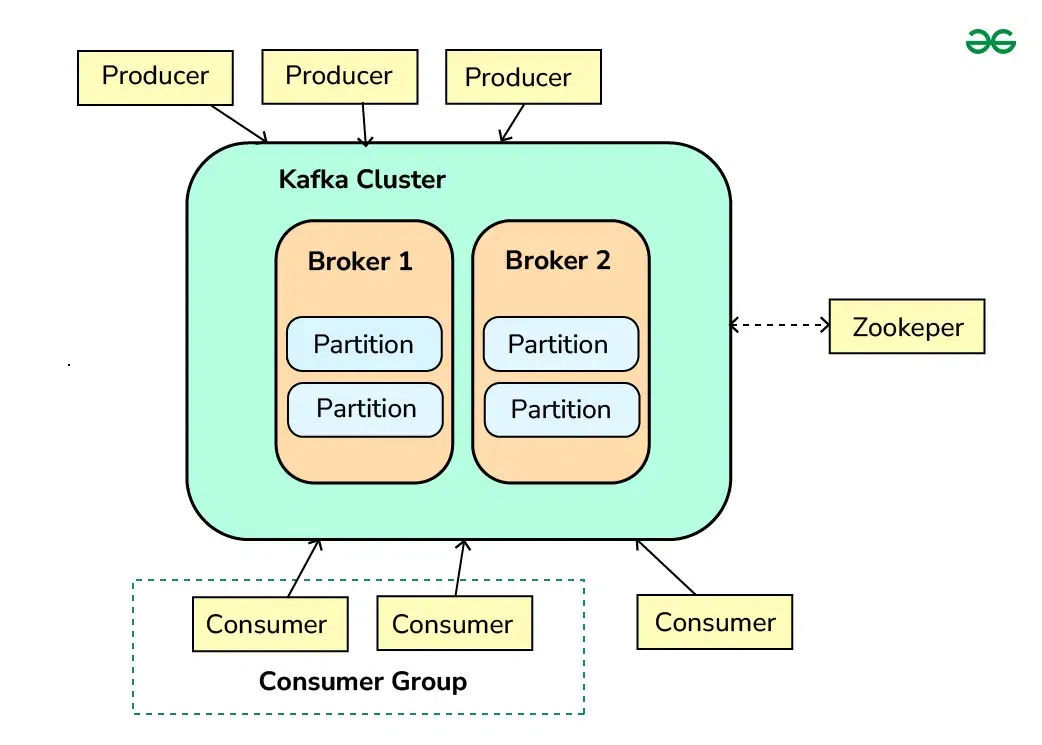
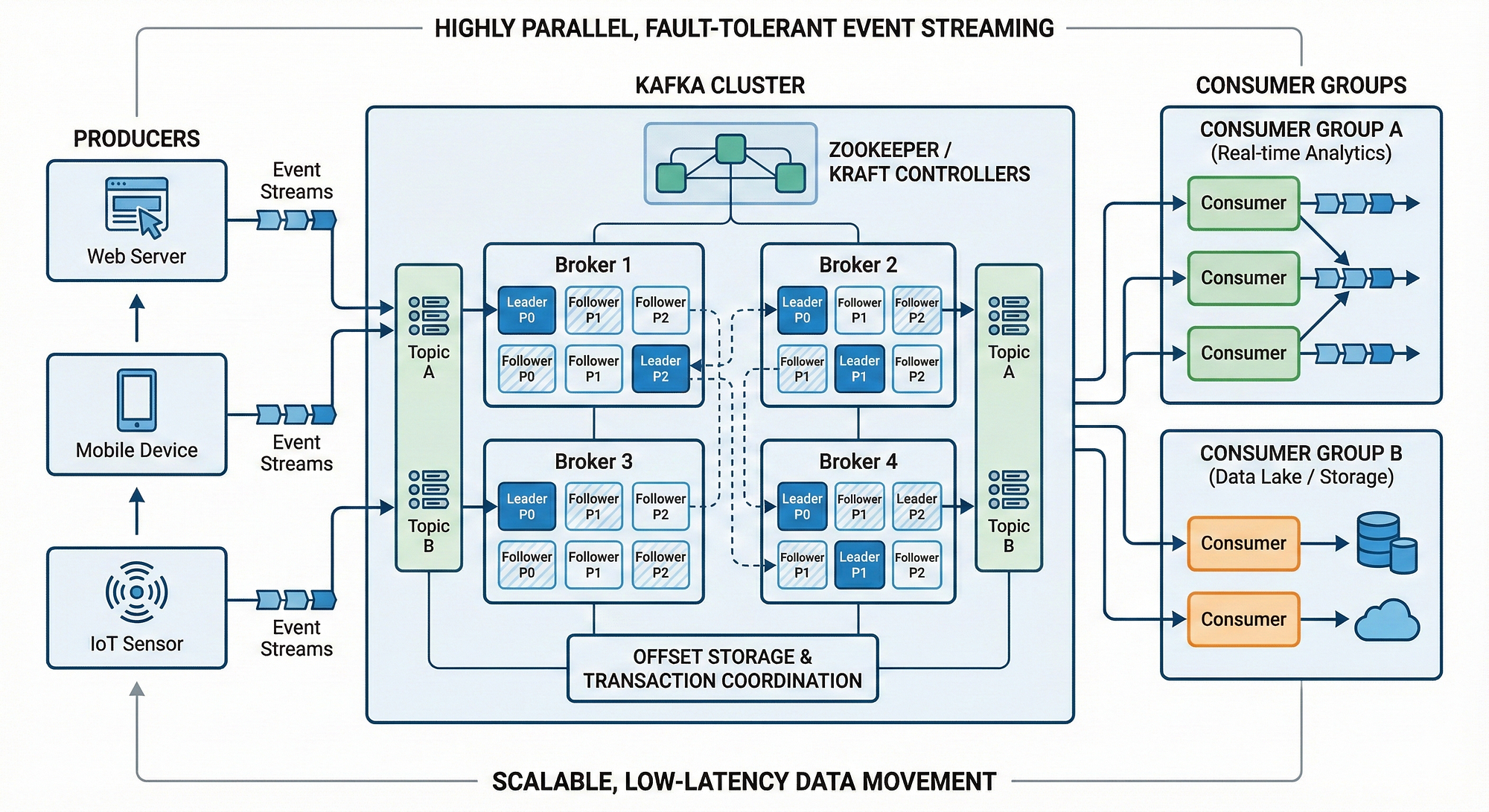
Apache Kafka mimarisi - Producer, Broker, Consumer modeli
Kafka, geleneksel message queue’lardan farklı olarak mesajları siler değil, belirli bir süre saklar (retention policy). Aynı mesajlar birden fazla consumer tarafından okunabilir.
Kafka Temel Kavramları
1. Topic (Konu)
1
2
3
4
5
6
# Topic, mesajların kategorize edildiği kanaldır
# Örnek topic'ler:
- user-registrations
- order-events
- payment-transactions
- sensor-data
2. Partition (Bölüm)
1
2
3
4
5
6
7
8
9
10
11
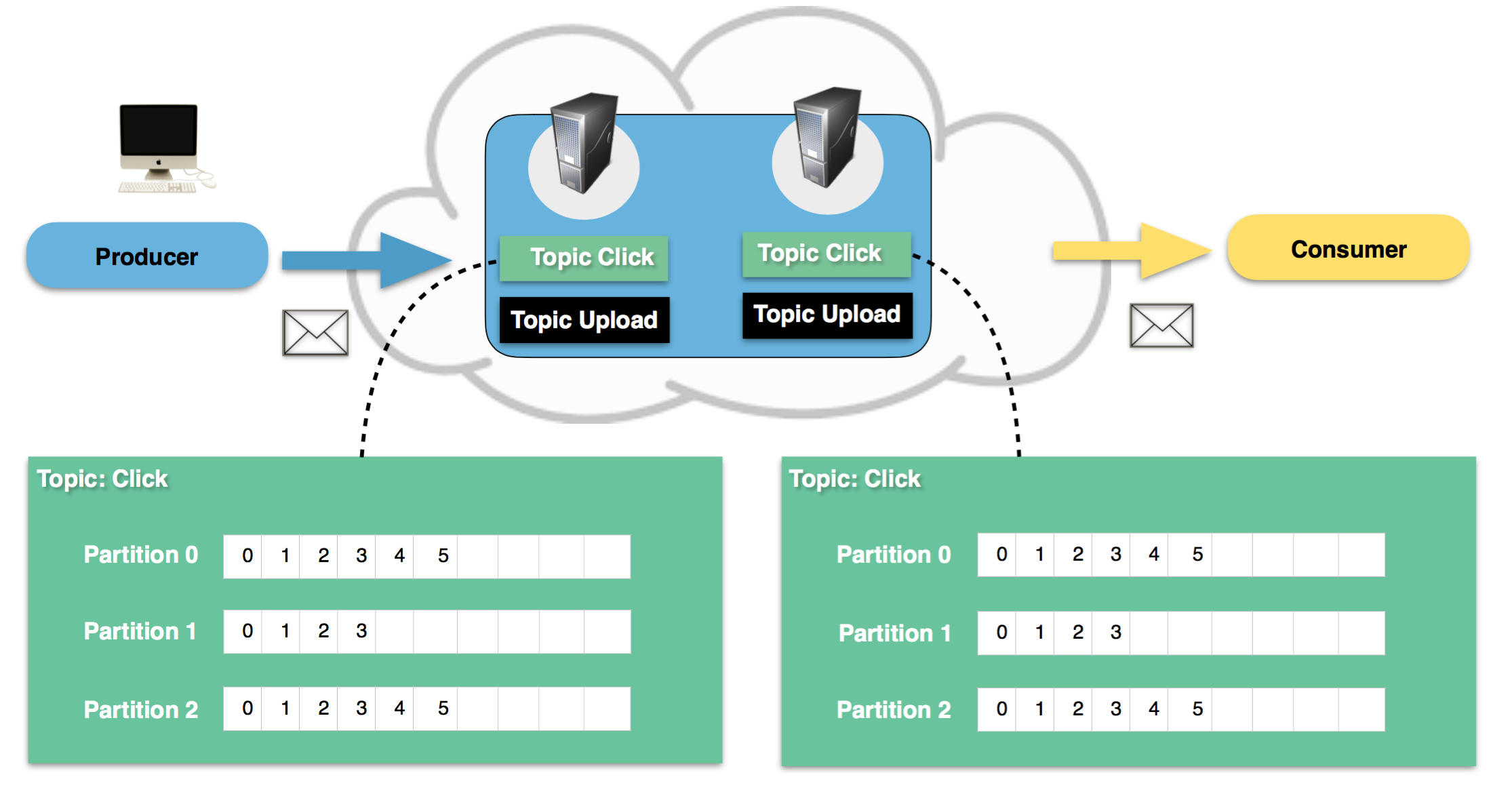
# Topic'ler partition'lara bölünür (paralel işlem için)
# Partition sayısı throughput'u belirler
# 3 partition'lu topic
user-events
├── partition-0
├── partition-1
└── partition-2
# Mesajlar key'e göre partition'lara dağıtılır
# Aynı key'e sahip mesajlar her zaman aynı partition'a gider
3. Producer (Üretici)
1
2
3
# Mesaj gönderen uygulamalar
# Topic'e mesaj yazar
# Partition seçimini yapabilir veya Kafka'ya bırakabilir
4. Consumer (Tüketici)
1
2
3
# Mesaj okuyan uygulamalar
# Consumer Group içinde çalışırlar
# Her partition bir consumer tarafından okunur
5. Broker
1
2
3
# Kafka sunucuları
# Mesajları saklar ve serve eder
# Cluster içinde replicate eder
6. Offset
1
2
3
# Her partition'daki mesajın benzersiz ID'si
# Consumer'lar offset'i takip ederek okumaya devam eder
# 0'dan başlar, sıralı artar
Kafka Kurulumu ve Konfigürasyonu
Docker ile Hızlı Kurulum
1
2
3
4
5
6
7
8
9
10
11
12
13
14
15
16
17
18
19
20
21
22
23
24
25
26
27
28
29
30
31
32
33
34
35
36
37
38
39
40
41
42
43
44
45
46
47
48
version: '3.8'
services:
zookeeper:
image: confluentinc/cp-zookeeper:7.5.0
environment:
ZOOKEEPER_CLIENT_PORT: 2181
ZOOKEEPER_TICK_TIME: 2000
ports:
- "2181:2181"
volumes:
- zookeeper-data:/var/lib/zookeeper/data
- zookeeper-logs:/var/lib/zookeeper/log
kafka:
image: confluentinc/cp-kafka:7.5.0
depends_on:
- zookeeper
ports:
- "9092:9092"
- "9093:9093"
environment:
KAFKA_BROKER_ID: 1
KAFKA_ZOOKEEPER_CONNECT: zookeeper:2181
KAFKA_ADVERTISED_LISTENERS: PLAINTEXT://localhost:9092,PLAINTEXT_INTERNAL://kafka:9093
KAFKA_LISTENER_SECURITY_PROTOCOL_MAP: PLAINTEXT:PLAINTEXT,PLAINTEXT_INTERNAL:PLAINTEXT
KAFKA_OFFSETS_TOPIC_REPLICATION_FACTOR: 1
KAFKA_AUTO_CREATE_TOPICS_ENABLE: "true"
KAFKA_LOG_RETENTION_HOURS: 168
KAFKA_LOG_SEGMENT_BYTES: 1073741824
volumes:
- kafka-data:/var/lib/kafka/data
kafka-ui:
image: provectuslabs/kafka-ui:latest
depends_on:
- kafka
ports:
- "8080:8080"
environment:
KAFKA_CLUSTERS_0_NAME: local
KAFKA_CLUSTERS_0_BOOTSTRAPSERVERS: kafka:9093
KAFKA_CLUSTERS_0_ZOOKEEPER: zookeeper:2181
volumes:
zookeeper-data:
zookeeper-logs:
kafka-data:
1
2
3
4
5
6
7
8
9
10
# Kafka'yı başlat
docker-compose up -d
# Kafka UI'a eriş: http://localhost:8080
# Kafka durumunu kontrol et
docker-compose ps
# Log'ları görüntüle
docker-compose logs -f kafka
Python Kafka Client Kurulumu
1
2
3
4
5
6
7
8
9
# kafka-python kütüphanesi
pip install kafka-python
# Alternatif: confluent-kafka (daha performanslı)
pip install confluent-kafka
# Avro serialization için
pip install avro-python3
pip install confluent-kafka[avro]
Kafka Producer: Mesaj Gönderme
Basit Producer
1
2
3
4
5
6
7
8
9
10
11
12
13
14
15
16
17
18
19
20
21
22
23
24
25
26
27
28
29
30
31
32
33
34
35
36
37
38
39
40
41
42
43
44
45
46
47
48
49
50
51
52
53
54
55
56
57
58
59
60
61
62
63
64
65
66
from kafka import KafkaProducer
import json
import time
from datetime import datetime
# Producer oluştur
producer = KafkaProducer(
bootstrap_servers=['localhost:9092'],
value_serializer=lambda v: json.dumps(v).encode('utf-8'),
key_serializer=lambda k: k.encode('utf-8') if k else None,
# Performans ve güvenilirlik ayarları
acks='all', # Tüm replica'lardan onay bekle
retries=3, # Hata durumunda yeniden deneme
max_in_flight_requests_per_connection=1, # Sıralama garantisi
compression_type='gzip', # Veri sıkıştırma
)
# Mesaj gönder
def send_message(topic, key, value):
"""
Topic'e mesaj gönder
Args:
topic: Topic adı
key: Mesaj key'i (partition seçimi için)
value: Mesaj içeriği (dict)
"""
try:
# Asenkron gönderim
future = producer.send(
topic=topic,
key=key,
value=value,
partition=None, # Key'e göre otomatik seçim
)
# Metadata al (blocking)
record_metadata = future.get(timeout=10)
print(f"Message sent to {record_metadata.topic}")
print(f"Partition: {record_metadata.partition}")
print(f"Offset: {record_metadata.offset}")
return record_metadata
except Exception as e:
print(f"Error sending message: {e}")
raise
# Örnek kullanım
user_event = {
'user_id': 12345,
'action': 'login',
'timestamp': datetime.now().isoformat(),
'ip_address': '192.168.1.1',
'device': 'mobile'
}
send_message(
topic='user-events',
key='user-12345', # Aynı user her zaman aynı partition'a
value=user_event
)
# Producer'ı kapat
producer.close()
Advanced Producer: Batch ve Callback
1
2
3
4
5
6
7
8
9
10
11
12
13
14
15
16
17
18
19
20
21
22
23
24
25
26
27
28
29
30
31
32
33
34
35
36
37
38
39
40
41
42
43
44
45
46
47
48
49
50
51
52
53
54
55
56
57
58
59
60
61
62
63
64
65
66
67
68
69
70
71
72
73
74
75
76
77
78
79
80
81
82
83
84
85
from kafka import KafkaProducer
from kafka.errors import KafkaError
import json
import logging
logging.basicConfig(level=logging.INFO)
logger = logging.getLogger(__name__)
class AdvancedProducer:
def __init__(self, bootstrap_servers=['localhost:9092']):
self.producer = KafkaProducer(
bootstrap_servers=bootstrap_servers,
value_serializer=lambda v: json.dumps(v).encode('utf-8'),
key_serializer=lambda k: k.encode('utf-8') if k else None,
# Batch ayarları (throughput için)
batch_size=16384, # 16KB batch
linger_ms=10, # 10ms bekle, batch'i doldur
buffer_memory=33554432, # 32MB buffer
# Güvenilirlik
acks='all',
retries=5,
retry_backoff_ms=100,
# Performans
compression_type='snappy',
max_in_flight_requests_per_connection=5,
)
self.success_count = 0
self.error_count = 0
def on_success(self, record_metadata):
"""Başarılı gönderim callback'i"""
self.success_count += 1
logger.info(
f"Message delivered to {record_metadata.topic} "
f"[{record_metadata.partition}] at offset {record_metadata.offset}"
)
def on_error(self, exc):
"""Hatalı gönderim callback'i"""
self.error_count += 1
logger.error(f"Message delivery failed: {exc}")
def send_async(self, topic, key, value):
"""Asenkron mesaj gönderimi"""
self.producer.send(topic, key=key, value=value) \
.add_callback(self.on_success) \
.add_errback(self.on_error)
def send_batch(self, topic, messages):
"""
Toplu mesaj gönderimi
Args:
topic: Topic adı
messages: [(key, value), ...] listesi
"""
for key, value in messages:
self.send_async(topic, key, value)
# Buffer'daki tüm mesajları gönder
self.producer.flush()
logger.info(f"Batch sent: {self.success_count} success, {self.error_count} errors")
def close(self):
"""Producer'ı kapat"""
self.producer.flush() # Bekleyen mesajları gönder
self.producer.close()
# Kullanım
producer = AdvancedProducer()
# Batch mesaj gönderimi
events = [
('user-1', {'action': 'login', 'timestamp': '2025-12-04T10:00:00'}),
('user-2', {'action': 'purchase', 'amount': 99.99}),
('user-3', {'action': 'logout', 'session_duration': 3600}),
]
producer.send_batch('user-events', events)
producer.close()
Kafka Consumer: Mesaj Okuma
Basit Consumer
1
2
3
4
5
6
7
8
9
10
11
12
13
14
15
16
17
18
19
20
21
22
23
24
25
26
27
28
29
30
31
32
33
34
35
36
37
38
39
40
41
42
43
44
45
46
47
48
49
50
51
52
53
54
from kafka import KafkaConsumer
import json
# Consumer oluştur
consumer = KafkaConsumer(
'user-events', # Topic adı
bootstrap_servers=['localhost:9092'],
value_deserializer=lambda m: json.loads(m.decode('utf-8')),
key_deserializer=lambda k: k.decode('utf-8') if k else None,
# Consumer group
group_id='user-events-group',
# Offset yönetimi
auto_offset_reset='earliest', # 'earliest' veya 'latest'
enable_auto_commit=True, # Otomatik offset commit
auto_commit_interval_ms=5000, # 5 saniyede bir commit
# Performans
max_poll_records=500, # Her poll'da maksimum mesaj
fetch_min_bytes=1, # Minimum fetch boyutu
fetch_max_wait_ms=500, # Maksimum bekleme
)
print("Listening for messages...")
try:
for message in consumer:
print(f"\n--- New Message ---")
print(f"Topic: {message.topic}")
print(f"Partition: {message.partition}")
print(f"Offset: {message.offset}")
print(f"Key: {message.key}")
print(f"Value: {message.value}")
print(f"Timestamp: {message.timestamp}")
# İş mantığı
process_event(message.value)
except KeyboardInterrupt:
print("\nShutting down consumer...")
finally:
consumer.close()
def process_event(event):
"""Event işleme mantığı"""
action = event.get('action')
if action == 'login':
print(f"User {event['user_id']} logged in")
elif action == 'purchase':
print(f"Purchase: ${event['amount']}")
elif action == 'logout':
print(f"Session ended: {event['session_duration']}s")
Advanced Consumer: Manuel Commit ve Error Handling
1
2
3
4
5
6
7
8
9
10
11
12
13
14
15
16
17
18
19
20
21
22
23
24
25
26
27
28
29
30
31
32
33
34
35
36
37
38
39
40
41
42
43
44
45
46
47
48
49
50
51
52
53
54
55
56
57
58
59
60
61
62
63
64
65
66
67
68
69
70
71
72
73
74
75
76
77
78
79
80
81
82
83
84
85
86
87
88
89
90
91
92
93
94
95
96
97
98
99
100
101
102
103
104
105
106
107
108
109
110
111
112
113
114
115
116
117
118
119
120
121
122
123
124
125
126
127
128
129
130
131
132
133
134
135
136
137
138
139
140
141
142
143
144
145
146
147
148
149
150
151
152
153
154
from kafka import KafkaConsumer, TopicPartition
from kafka.errors import KafkaError
import json
import logging
logging.basicConfig(level=logging.INFO)
logger = logging.getLogger(__name__)
class AdvancedConsumer:
def __init__(self, topics, group_id, bootstrap_servers=['localhost:9092']):
self.consumer = KafkaConsumer(
*topics,
bootstrap_servers=bootstrap_servers,
value_deserializer=lambda m: json.loads(m.decode('utf-8')),
key_deserializer=lambda k: k.decode('utf-8') if k else None,
group_id=group_id,
# Manuel commit
enable_auto_commit=False,
# Performans ayarları
max_poll_records=100,
max_poll_interval_ms=300000, # 5 dakika
session_timeout_ms=10000, # 10 saniye
heartbeat_interval_ms=3000, # 3 saniye
)
self.processed_count = 0
self.error_count = 0
def process_message(self, message):
"""
Mesajı işle
Returns:
bool: Başarılı ise True
"""
try:
logger.info(f"Processing message from offset {message.offset}")
# İş mantığı
event = message.value
action = event.get('action')
if action == 'login':
self.handle_login(event)
elif action == 'purchase':
self.handle_purchase(event)
else:
logger.warning(f"Unknown action: {action}")
self.processed_count += 1
return True
except Exception as e:
logger.error(f"Error processing message: {e}")
self.error_count += 1
return False
def handle_login(self, event):
"""Login event handler"""
logger.info(f"User {event['user_id']} logged in from {event.get('ip_address')}")
# Database'e yaz, cache güncelle, vs.
def handle_purchase(self, event):
"""Purchase event handler"""
logger.info(f"Purchase: ${event['amount']} by user {event['user_id']}")
# Payment processing, inventory update, vs.
def consume(self, max_messages=None):
"""
Mesajları consume et
Args:
max_messages: Maksimum mesaj sayısı (None = sınırsız)
"""
messages_consumed = 0
try:
while True:
# Poll messages
message_batch = self.consumer.poll(
timeout_ms=1000,
max_records=100
)
if not message_batch:
continue
# Her partition için
for topic_partition, messages in message_batch.items():
logger.info(
f"Received {len(messages)} messages from "
f"{topic_partition.topic}[{topic_partition.partition}]"
)
# Mesajları işle
for message in messages:
success = self.process_message(message)
if success:
# Başarılı ise offset'i commit et
self.consumer.commit()
messages_consumed += 1
else:
# Hatalı mesajı dead letter queue'ya gönder
self.send_to_dlq(message)
# Yine de commit et (sonsuz loop'tan kaçınmak için)
self.consumer.commit()
# Maksimum mesaj sayısına ulaşıldı mı?
if max_messages and messages_consumed >= max_messages:
break
except KeyboardInterrupt:
logger.info("Consumer interrupted by user")
finally:
self.close()
def send_to_dlq(self, message):
"""Dead Letter Queue'ya mesaj gönder"""
logger.warning(f"Sending message to DLQ: offset {message.offset}")
# DLQ topic'ine gönder
# producer.send('user-events-dlq', message.value)
def seek_to_beginning(self):
"""Tüm partition'ları başa sar"""
self.consumer.seek_to_beginning()
def seek_to_offset(self, topic, partition, offset):
"""Belirli offset'e git"""
tp = TopicPartition(topic, partition)
self.consumer.seek(tp, offset)
def get_current_offsets(self):
"""Mevcut offset'leri al"""
return {
tp: self.consumer.position(tp)
for tp in self.consumer.assignment()
}
def close(self):
"""Consumer'ı kapat"""
logger.info(f"Processed: {self.processed_count}, Errors: {self.error_count}")
self.consumer.close()
# Kullanım
consumer = AdvancedConsumer(
topics=['user-events', 'order-events'],
group_id='analytics-group'
)
consumer.consume()
Consumer Groups ve Partition Rebalancing
1
2
3
4
5
6
7
8
9
10
11
12
13
14
15
16
17
18
19
20
21
22
23
24
25
26
27
28
29
30
31
32
33
34
35
36
37
38
39
40
41
42
43
44
45
46
47
48
49
50
51
52
53
54
55
56
57
58
59
60
61
62
63
from kafka import KafkaConsumer
import threading
import time
class ConsumerGroupExample:
"""
Consumer Group örneği
Aynı group_id'ye sahip consumer'lar partition'ları paylaşır
"""
@staticmethod
def create_consumer(consumer_id, group_id):
"""Consumer oluştur ve mesajları consume et"""
consumer = KafkaConsumer(
'user-events',
bootstrap_servers=['localhost:9092'],
group_id=group_id,
value_deserializer=lambda m: json.loads(m.decode('utf-8')),
auto_offset_reset='earliest',
)
print(f"Consumer {consumer_id} started")
try:
for message in consumer:
print(
f"[Consumer {consumer_id}] "
f"Partition: {message.partition}, "
f"Offset: {message.offset}"
)
time.sleep(0.1) # Simulated processing
finally:
consumer.close()
@staticmethod
def run_consumer_group():
"""
3 consumer'lı bir group çalıştır
Eğer topic 3 partition'a sahipse:
- Her consumer 1 partition alır
- Paralel işlem olur
Eğer topic 6 partition'a sahipse:
- Her consumer 2 partition alır
"""
threads = []
group_id = 'demo-group'
for i in range(3):
thread = threading.Thread(
target=ConsumerGroupExample.create_consumer,
args=(i, group_id)
)
thread.start()
threads.append(thread)
# Wait for all consumers
for thread in threads:
thread.join()
# Çalıştır
# ConsumerGroupExample.run_consumer_group()
Gerçek Dünya Kullanım Senaryoları
1. Real-time Analytics Pipeline
1
2
3
4
5
6
7
8
9
10
11
12
13
14
15
16
17
18
19
20
21
22
23
24
25
26
27
28
29
30
31
32
33
34
35
36
37
38
39
40
41
42
43
44
45
46
47
48
49
50
51
52
53
54
55
56
57
58
59
60
61
62
63
64
65
66
67
68
69
70
71
72
73
74
75
76
77
78
79
80
81
82
83
84
85
86
87
88
89
90
91
92
93
94
95
from kafka import KafkaConsumer, KafkaProducer
import json
from datetime import datetime
from collections import defaultdict
import time
class RealTimeAnalytics:
"""
Gerçek zamanlı analitik pipeline
User event'lerini consume eder, aggregate eder ve sonuçları yazar
"""
def __init__(self):
self.consumer = KafkaConsumer(
'user-events',
bootstrap_servers=['localhost:9092'],
group_id='analytics-pipeline',
value_deserializer=lambda m: json.loads(m.decode('utf-8')),
)
self.producer = KafkaProducer(
bootstrap_servers=['localhost:9092'],
value_serializer=lambda v: json.dumps(v).encode('utf-8'),
)
# Metrics storage (5 dakikalık window)
self.window_size = 300 # 5 minutes
self.metrics = defaultdict(lambda: {
'login_count': 0,
'purchase_count': 0,
'total_revenue': 0.0,
'unique_users': set(),
'start_time': time.time()
})
def process_event(self, event):
"""Event'i işle ve metrics'i güncelle"""
current_window = int(time.time() / self.window_size)
window_metrics = self.metrics[current_window]
action = event.get('action')
user_id = event.get('user_id')
# Unique user sayısı
window_metrics['unique_users'].add(user_id)
# Action'a göre metrics
if action == 'login':
window_metrics['login_count'] += 1
elif action == 'purchase':
window_metrics['purchase_count'] += 1
window_metrics['total_revenue'] += event.get('amount', 0)
def publish_metrics(self, window_id, metrics):
"""Aggregated metrics'i yayınla"""
result = {
'window_id': window_id,
'timestamp': datetime.now().isoformat(),
'login_count': metrics['login_count'],
'purchase_count': metrics['purchase_count'],
'total_revenue': metrics['total_revenue'],
'unique_users': len(metrics['unique_users']),
'duration': self.window_size
}
self.producer.send('analytics-results', value=result)
print(f"Published metrics: {result}")
def run(self):
"""Analytics pipeline'ı çalıştır"""
last_window = None
try:
for message in self.consumer:
event = message.value
self.process_event(event)
# Window değişti mi kontrol et
current_window = int(time.time() / self.window_size)
if last_window and current_window != last_window:
# Önceki window'u publish et
self.publish_metrics(last_window, self.metrics[last_window])
# Eski window'u sil (memory tasarrufu)
del self.metrics[last_window]
last_window = current_window
finally:
self.consumer.close()
self.producer.close()
# Çalıştır
# analytics = RealTimeAnalytics()
# analytics.run()
2. Event-Driven Microservices
1
2
3
4
5
6
7
8
9
10
11
12
13
14
15
16
17
18
19
20
21
22
23
24
25
26
27
28
29
30
31
32
33
34
35
36
37
38
39
40
41
42
43
44
45
46
47
48
49
50
51
52
53
54
55
56
57
58
59
60
61
62
63
64
65
66
67
68
69
70
71
72
73
74
75
76
77
78
79
80
81
82
83
84
85
86
87
88
89
90
91
92
93
94
95
96
97
98
99
100
101
102
103
104
105
106
107
108
109
110
111
112
113
114
115
116
117
118
119
120
121
122
123
124
125
126
127
128
129
130
131
132
133
134
135
136
137
138
139
140
141
142
143
144
145
146
147
148
from kafka import KafkaConsumer, KafkaProducer
import json
import logging
logging.basicConfig(level=logging.INFO)
logger = logging.getLogger(__name__)
class OrderService:
"""
Order microservice
Order event'lerini consume eder ve diğer servislere event yayınlar
"""
def __init__(self):
self.consumer = KafkaConsumer(
'order-created',
bootstrap_servers=['localhost:9092'],
group_id='order-service',
value_deserializer=lambda m: json.loads(m.decode('utf-8')),
)
self.producer = KafkaProducer(
bootstrap_servers=['localhost:9092'],
value_serializer=lambda v: json.dumps(v).encode('utf-8'),
)
def process_order(self, order):
"""
Sipariş işleme workflow'u
1. Inventory check
2. Payment processing
3. Shipping arrangement
4. Notification
"""
order_id = order['order_id']
try:
# 1. Inventory Service'e event gönder
inventory_event = {
'order_id': order_id,
'items': order['items'],
'timestamp': datetime.now().isoformat()
}
self.producer.send('inventory-check-requested', value=inventory_event)
logger.info(f"Inventory check requested for order {order_id}")
# 2. Payment Service'e event gönder
payment_event = {
'order_id': order_id,
'amount': order['total_amount'],
'payment_method': order['payment_method']
}
self.producer.send('payment-requested', value=payment_event)
logger.info(f"Payment requested for order {order_id}")
# 3. Order status güncelle
status_event = {
'order_id': order_id,
'status': 'processing',
'timestamp': datetime.now().isoformat()
}
self.producer.send('order-status-updated', value=status_event)
except Exception as e:
logger.error(f"Error processing order {order_id}: {e}")
# Failure event'i gönder
self.producer.send('order-failed', value={
'order_id': order_id,
'error': str(e)
})
def run(self):
"""Service'i çalıştır"""
logger.info("Order Service started")
try:
for message in self.consumer:
order = message.value
self.process_order(order)
finally:
self.consumer.close()
self.producer.close()
class PaymentService:
"""Payment microservice"""
def __init__(self):
self.consumer = KafkaConsumer(
'payment-requested',
bootstrap_servers=['localhost:9092'],
group_id='payment-service',
value_deserializer=lambda m: json.loads(m.decode('utf-8')),
)
self.producer = KafkaProducer(
bootstrap_servers=['localhost:9092'],
value_serializer=lambda v: json.dumps(v).encode('utf-8'),
)
def process_payment(self, payment_request):
"""Ödeme işlemi"""
order_id = payment_request['order_id']
amount = payment_request['amount']
try:
# Payment gateway ile iletişim
success = self.charge_payment(amount, payment_request['payment_method'])
if success:
# Success event
self.producer.send('payment-completed', value={
'order_id': order_id,
'amount': amount,
'status': 'success'
})
logger.info(f"Payment completed for order {order_id}")
else:
# Failure event
self.producer.send('payment-failed', value={
'order_id': order_id,
'reason': 'insufficient_funds'
})
logger.warning(f"Payment failed for order {order_id}")
except Exception as e:
logger.error(f"Payment error for order {order_id}: {e}")
self.producer.send('payment-failed', value={
'order_id': order_id,
'reason': str(e)
})
def charge_payment(self, amount, method):
"""Simulated payment processing"""
import random
return random.random() > 0.1 # 90% success rate
def run(self):
"""Service'i çalıştır"""
logger.info("Payment Service started")
try:
for message in self.consumer:
payment_request = message.value
self.process_payment(payment_request)
finally:
self.consumer.close()
self.producer.close()
3. Log Aggregation
1
2
3
4
5
6
7
8
9
10
11
12
13
14
15
16
17
18
19
20
21
22
23
24
25
26
27
28
29
30
31
32
33
34
35
36
37
38
39
40
41
42
43
44
45
46
47
48
49
50
51
52
53
54
55
56
57
58
59
60
61
62
63
64
65
66
67
68
69
70
71
72
73
74
75
76
77
78
79
80
81
from kafka import KafkaConsumer
import json
import logging
from elasticsearch import Elasticsearch
from datetime import datetime
class LogAggregator:
"""
Log aggregation service
Farklı microservice'lerden gelen log'ları toplar ve Elasticsearch'e yazar
"""
def __init__(self):
self.consumer = KafkaConsumer(
'application-logs',
bootstrap_servers=['localhost:9092'],
group_id='log-aggregator',
value_deserializer=lambda m: json.loads(m.decode('utf-8')),
)
# Elasticsearch client
self.es = Elasticsearch(['http://localhost:9200'])
self.index_name = 'application-logs'
def process_log(self, log_entry):
"""Log entry'sini Elasticsearch'e yaz"""
try:
# Log entry'yi zenginleştir
enriched_log = {
**log_entry,
'ingestion_time': datetime.now().isoformat(),
'timestamp': log_entry.get('timestamp', datetime.now().isoformat())
}
# Elasticsearch'e index et
self.es.index(
index=self.index_name,
body=enriched_log
)
# Critical log'lar için alert
if log_entry.get('level') == 'ERROR':
self.send_alert(log_entry)
except Exception as e:
logging.error(f"Error processing log: {e}")
def send_alert(self, log_entry):
"""Critical log için alert gönder"""
# Slack, email, PagerDuty, vs.
print(f"ALERT: {log_entry['service']} - {log_entry['message']}")
def run(self):
"""Aggregator'ı çalıştır"""
print("Log Aggregator started")
try:
for message in self.consumer:
log_entry = message.value
self.process_log(log_entry)
finally:
self.consumer.close()
# Log producer (her microservice'ten)
def send_log(service_name, level, message):
"""Log mesajı gönder"""
producer = KafkaProducer(
bootstrap_servers=['localhost:9092'],
value_serializer=lambda v: json.dumps(v).encode('utf-8'),
)
log_entry = {
'service': service_name,
'level': level,
'message': message,
'timestamp': datetime.now().isoformat(),
'host': 'server-1'
}
producer.send('application-logs', value=log_entry)
producer.close()
Kafka Monitoring ve Best Practices
Monitoring Metrics
1
2
3
4
5
6
7
8
9
10
11
12
13
14
15
16
17
18
19
20
21
22
23
24
25
26
27
28
29
30
31
32
33
34
35
36
37
38
39
40
41
42
43
44
45
46
47
48
49
50
from kafka import KafkaAdminClient
from kafka.admin import NewTopic
class KafkaMonitor:
"""Kafka cluster monitoring"""
def __init__(self):
self.admin_client = KafkaAdminClient(
bootstrap_servers=['localhost:9092']
)
def get_cluster_info(self):
"""Cluster bilgilerini al"""
cluster = self.admin_client._client.cluster
print("Kafka Cluster Info:")
print(f"Brokers: {len(cluster.brokers())}")
for broker in cluster.brokers():
print(f" - Broker {broker.nodeId}: {broker.host}:{broker.port}")
print(f"\nTopics: {len(cluster.topics())}")
for topic in cluster.topics():
partitions = cluster.partitions_for_topic(topic)
print(f" - {topic}: {len(partitions)} partitions")
def create_topic(self, name, partitions=3, replication_factor=1):
"""Yeni topic oluştur"""
topic = NewTopic(
name=name,
num_partitions=partitions,
replication_factor=replication_factor
)
try:
self.admin_client.create_topics([topic])
print(f"Topic '{name}' created successfully")
except Exception as e:
print(f"Error creating topic: {e}")
def delete_topic(self, name):
"""Topic sil"""
try:
self.admin_client.delete_topics([name])
print(f"Topic '{name}' deleted successfully")
except Exception as e:
print(f"Error deleting topic: {e}")
# Kullanım
monitor = KafkaMonitor()
monitor.get_cluster_info()
Best Practices
1
2
3
4
5
6
7
8
9
10
11
12
13
14
15
16
17
18
19
20
21
22
23
24
25
26
27
28
29
30
31
32
33
34
35
36
37
38
39
40
41
42
43
44
45
46
47
48
49
50
"""
Kafka Best Practices
"""
# 1. Message Key Seçimi
# ✅ İyi: Partition balance için iyi key
producer.send('user-events', key=str(user_id), value=event)
# ❌ Kötü: Aynı key her zaman (partition imbalance)
producer.send('user-events', key='fixed-key', value=event)
# 2. Batch Processing
# ✅ İyi: Batch'lerle işle
messages = consumer.poll(timeout_ms=1000, max_records=100)
for topic_partition, records in messages.items():
process_batch(records) # Toplu işlem
consumer.commit()
# ❌ Kötü: Her mesajı ayrı commit
for message in consumer:
process(message)
consumer.commit() # Her mesajda commit (yavaş)
# 3. Error Handling
# ✅ İyi: Retry ve DLQ
try:
process_message(message)
consumer.commit()
except Exception as e:
if is_retriable(e):
retry_later(message)
else:
send_to_dlq(message)
consumer.commit() # İlerle
# 4. Idempotent Processing
# ✅ İyi: Idempotent tasarım
def process_order(order_id):
if already_processed(order_id):
return # Skip duplicate
# Process...
mark_as_processed(order_id)
# 5. Monitoring
# Kritik metrics:
# - Consumer lag (topic offset - consumer offset)
# - Throughput (messages/sec)
# - Error rate
# - Partition distribution
Sonuç
Apache Kafka, modern veri mühendisliği ve event-driven architecture’ların temel taşıdır. Bu yazıda ele aldığımız konular:
- Kafka temel kavramları: Topic, partition, offset, consumer group
- Python implementation: kafka-python ile producer/consumer
- Advanced patterns: Batch processing, error handling, DLQ
- Real-world use cases: Analytics pipeline, microservices, log aggregation
- Best practices: Performance, reliability, monitoring
Kafka Kullanım Senaryoları:
- Real-time analytics ve metrics
- Event-driven microservices
- Log aggregation ve monitoring
- Stream processing (Kafka Streams, Flink)
- CDC (Change Data Capture)
- Message queue ve pub/sub
Dikkat Edilmesi Gerekenler:
- Consumer lag’i düzenli monitor edin
- Partition sayısını throughput’a göre ayarlayın
- Replication factor ile fault-tolerance sağlayın
- Idempotent processing tasarlayın
- Dead letter queue stratejisi kullanın
Kafka, yüksek throughput, düşük latency ve güvenilirlik gerektiren tüm uygulamalarda tercih edilen bir çözümdür.