

Every Python library and service I write is tested with pytest. This post collects the advanced pytest techniques I actually use: fixture scopes, parametrize, mocking, async tests, property-based testing with Hypothesis, and CI settings. Everything here targets pytest 8, and the parametrize and RaisesGroup examples also run on pytest 9.1.
A note before starting: unittest is fine. It's in the standard library and it works. But writing classes, remembering self.assertEqual, and jumping between setUp and tearDown makes tests feel like a chore. pytest does the same job with plain functions and plain assert, and on failure it shows both sides of the expression in detail. It also runs existing unittest tests unchanged, so you can migrate gradually.
Configure the project up front#
All the settings live in pyproject.toml:
[tool.pytest.ini_options]
minversion = "8.0"
testpaths = ["tests"]
addopts = ["-ra", "--strict-markers", "--strict-config"]
xfail_strict = true
markers = [
    "slow: long-running tests (run separately in CI)",
]
--strict-markers turns a typo like @pytest.mark.slwo into an error instead of silently ignoring it. xfail_strict fails tests marked xfail that start passing, so fixed bugs don't stay marked as broken. -ra prints a summary of why tests were skipped or failed at the end of the run.
Fixtures and scope#
A fixture prepares what a test needs and cleans up afterwards: setup before yield, teardown after. Scope decides how long the fixture lives: function (the default), class, module, package or session. This diagram from the pytest docs shows that wider-scoped fixtures are set up first:
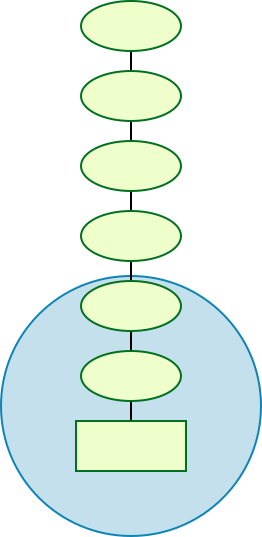
The pattern I get the most out of: open expensive resources (a database engine, a Docker container) once at session scope, and give each test a cheap, isolated slice of it. With SQLAlchemy 2, running every test inside a transaction that gets rolled back looks like this:
# tests/conftest.py
import os

import pytest
from sqlalchemy import create_engine
from sqlalchemy.orm import Session

from app.models import Base


@pytest.fixture(scope="session")
def engine():
    engine = create_engine(os.environ["TEST_DATABASE_URL"])
    Base.metadata.create_all(engine)
    yield engine
    Base.metadata.drop_all(engine)
    engine.dispose()


@pytest.fixture
def db_session(engine):
    with engine.connect() as connection:
        transaction = connection.begin()
        session = Session(bind=connection, join_transaction_mode="create_savepoint")
        yield session
        session.close()
        transaction.rollback()
With join_transaction_mode="create_savepoint", the code under test can call session.commit() without breaking the outer transaction. When the test ends, everything is rolled back and the next test sees a clean database.
Fixtures in conftest.py are available to every test in that directory and below, with no import needed.
Factory fixtures#
Sometimes a test needs several objects of the same kind. Having the fixture return a function that builds them keeps things tidy:
@pytest.fixture
def make_user(db_session):
    def _make(name: str = "furkan", is_admin: bool = False) -> User:
        user = User(name=name, is_admin=is_admin)
        db_session.add(user)
        db_session.flush()
        return user

    return _make


def test_admin_can_delete(make_user):
    admin = make_user("admin", is_admin=True)
    target = make_user("target")
    assert admin.can_delete(target)
Built-in fixtures#
Check pytest's built-ins before writing your own. The ones I use most:
def test_writes_report(tmp_path, monkeypatch, caplog):
    monkeypatch.setenv("REPORT_DIR", str(tmp_path))
    write_report({"ok": True})
    assert (tmp_path / "report.json").exists()
    assert "report written" in caplog.text
tmp_path is a fresh temporary directory per test, monkeypatch changes environment variables and attributes and restores them afterwards, and caplog captures log output.
One test, many cases with parametrize#
When testing one function with different inputs, use parametrize instead of copy-paste. pytest.param gives each case a readable id and, if needed, a marker:
import pytest


@pytest.mark.parametrize(
    ("email", "expected"),
    [
        pytest.param("test@example.com", True, id="simple"),
        pytest.param("user+tag@gmail.com", True, id="plus-tag"),
        pytest.param("plainaddress", False, id="no-at"),
        pytest.param("@example.com", False, id="no-local-part"),
        pytest.param("ü@exämple.com", True, id="unicode", marks=pytest.mark.xfail(reason="no IDN support yet")),
    ],
)
def test_is_valid_email(email, expected):
    assert is_valid_email(email) is expected
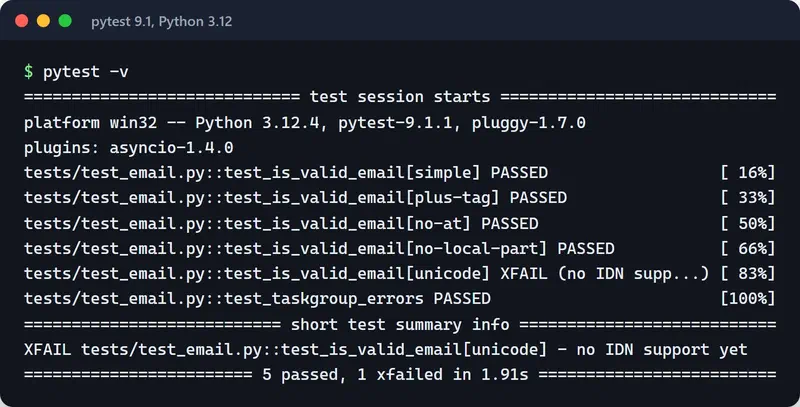
Failures show up as test_is_valid_email[no-at], and pytest -k unicode runs a single case.
With a simple regex-based is_valid_email, the RaisesGroup test from further down and the pyproject.toml settings above, pytest -v prints this. The unicode case is an expected XFAIL, and -ra repeats the reason in the summary:
Mocking: keep the outside world out#
A unit test should not hit the internet. A test that really calls a payment API is slow, flaky and, in the worst case, expensive. The mocker fixture from pytest-mock wraps unittest.mock and undoes every patch automatically when the test ends:
# app/payments.py
import httpx


def charge(amount: int) -> str:
    resp = httpx.post("https://api.payments.example/charge", json={"amount": amount}, timeout=10)
    resp.raise_for_status()
    return resp.json()["status"]


# tests/test_payments.py
from app.payments import charge


def test_charge_success(mocker):
    post = mocker.patch("app.payments.httpx.post", autospec=True)
    post.return_value.json.return_value = {"status": "success"}

    assert charge(100) == "success"
    post.assert_called_once_with(
        "https://api.payments.example/charge", json={"amount": 100}, timeout=10
    )
Patch where the name is used (app.payments.httpx.post), not where it's defined. autospec=True makes the fake match the real function's signature, so a call with wrong arguments fails the test.
If your HTTP client is httpx, mocking the network layer with respx is cleaner than patching functions. That's how the tests in speedapi_lib, a Python SDK I wrote, are set up: a fixture in conftest.py opens a respx router for the API's base URL, and each test defines its own responses:
import httpx
import pytest
import respx

BASE_URL = "https://api.example.com"


@pytest.fixture
def mock_router():
    with respx.mock(base_url=BASE_URL, assert_all_called=False) as router:
        yield router


def test_get_balance(mock_router):
    mock_router.get("/balance").mock(return_value=httpx.Response(200, json={"amount": 10}))
    resp = httpx.get(f"{BASE_URL}/balance")
    assert resp.json() == {"amount": 10}
A request to a route you didn't mock raises an error, so no test can accidentally reach the real API.
Testing async code#
For async tests I use pytest-asyncio. Both speedapi_lib and Quorum use the same configuration:
[tool.pytest.ini_options]
asyncio_mode = "auto"
asyncio_default_fixture_loop_scope = "function"
In auto mode every async def test_... runs without a marker, and async fixtures are declared with the regular @pytest.fixture. pytest-asyncio 1.0 removed the old event_loop fixture; if you need a wider loop, use @pytest.mark.asyncio(loop_scope="module").
Mock async functions with AsyncMock. For TaskGroup, timeouts and the rest, see the asyncio post.
What changed in pytest 8#
A few changes in the pytest 8 series worth knowing about:
- Since 8.4, an async test function with no plugin to run it fails outright instead of warning and being skipped. If you had async tests that were silently skipped, CI may go red.
- Also since 8.4, a test function that returns anything other than
Nonefails. A test that returns a value has usually forgotten itsassert. - 8.4 added
pytest.RaisesGroupfor theExceptionGroups that TaskGroup raises:
import asyncio

import pytest


async def test_taskgroup_errors():
    async def boom():
        raise ValueError("bad data")

    with pytest.RaisesGroup(ValueError, ValueError):
        async with asyncio.TaskGroup() as tg:
            tg.create_task(boom())
            tg.create_task(boom())
For a single exception, pytest.raises(ValueError, match="bad") is still the right tool. match takes a regex; use it to check the message too.
Property-based testing with Hypothesis#
Hand-written examples test the cases you thought of. Hypothesis asks you for a rule and then searches for input that breaks it: empty strings, zero, negative numbers, odd Unicode. When it finds a failure, it shrinks the input to the smallest example and shows you that.
The most useful rule is the round trip: serialize, deserialize, get the same thing back.
import json

from hypothesis import given
from hypothesis import strategies as st


@given(st.dictionaries(st.text(), st.integers() | st.text() | st.none()))
def test_json_roundtrip(data):
    assert json.loads(json.dumps(data)) == data
If your code has pairs like encode/decode or to_dict/from_dict, this pattern catches real bugs in a few lines. For pricing code you can write rules like "the total is never negative" or "a discount never exceeds the price".
Snapshot tests#
Asserting a large JSON response or generated HTML line by line is tedious. syrupy stores the output in a file on the first run and compares against it afterwards:
def test_report_output(snapshot):
    assert build_report(month="2025-09") == snapshot
When you change the output on purpose, pytest --snapshot-update rewrites the stored snapshots. The change shows up in the git diff, so it gets seen in review. The only real risk is someone running --snapshot-update without looking.
Speed and coverage in CI#
The plugins I use:
pytest-xdist:-n autospreads tests across one process per core. Hidden dependencies between tests show up here, which is a good thing.pytest-cov:--cov=src --cov-report=term-missingshows which lines are untested. I look at missing lines in critical files rather than chasing a percentage.pytest-rerunfailures: retries a flaky test with@pytest.mark.flaky(reruns=2). Use it as a stopgap and go find the root cause (a race, a fixedsleep, test order).
The command I usually run in CI:
pytest -n auto --cov=src --cov-report=term-missing --durations=10--durations=10 lists the ten slowest tests. A unit test that takes seconds usually means a forgotten sleep or a real network call. The GitHub Actions side is covered in the CI/CD post.
Habits I avoid#
- Branching with
ifinside a test. If you need a branch, write two tests or parametrize. - Tests that depend on each other. If
test_2can't pass withouttest_1, things break as soon as tests run in random order (pytest-randomly) or in parallel. - Waiting for something with
time.sleep(). Poll for the condition in a short loop, or use anEventin async code. - Mocking everything. Once you're mocking your own internal functions, the test checks implementation details rather than behavior.
Where to start#
Add the pyproject.toml settings above to an existing project and run pytest -ra --durations=10. You'll immediately see which tests are skipped and which are slow. Then find an encode/decode pair in your code and write one Hypothesis test for it.
Docs: pytest, pytest-asyncio, Hypothesis, respx, syrupy.


