

The pitch for gRPC high-performance APIs is short: binary Protobuf messages instead of JSON, HTTP/2 instead of HTTP/1.1, and typed code generated from a schema instead of a hand-written client. Between services, those three make a real difference. For an API that browsers call, REST is still usually the more practical choice.
In this post I write a service with the asyncio API of grpcio (grpc.aio), then cover what came up once it ran in production: deadlines, status codes, interceptors, schema evolution and load balancing. I ran the server and client examples with Python 3.12 and grpcio 1.84.
When gRPC makes sense#
REST/JSON has known costs for internal traffic: field names travel with every message, parsing text burns CPU, and only the documentation tells you whether a field is a string or an int. In gRPC the contract is a .proto file, and client and server code for every language is generated from it.
How I choose:
| REST (JSON) | gRPC (Protobuf) | |
|---|---|---|
| Payload | Text, human-readable | Binary, compact |
| Transport | Usually HTTP/1.1 | HTTP/2 |
| Contract | OpenAPI (optional) | .proto (required) |
| Streaming | Separately, via SSE or WebSocket | Four call types built in |
| Browser | Direct | Needs gRPC-Web or Connect |
| Debugging | curl | grpcurl, reflection |
I use gRPC for east-west traffic between services, especially when they're written in different languages or need streaming. For a public API, a backend the browser calls directly or a simple CRUD app, REST with FastAPI has less friction.
The contract: a .proto file#
Everything in gRPC starts from one .proto file. protoc generates the message classes and stubs from it, and both server and client build on that generated code.
A small price service with one unary and one server-streaming method:
// proto/stocks.proto
syntax = "proto3";

package stocks.v1;

service StockService {
  rpc GetPrice(PriceRequest) returns (PriceReply);
  rpc StreamPrices(PriceRequest) returns (stream PriceReply);
}

message PriceRequest {
  string symbol = 1;
}

message PriceReply {
  string symbol = 1;
  double price = 2;
  int64 ts_ms = 3;
}
Generate the code:
pip install grpcio grpcio-tools
python -m grpc_tools.protoc -I proto --python_out=. --pyi_out=. --grpc_python_out=. proto/stocks.proto
That produces stocks_pb2.py (messages), stocks_pb2.pyi (type hints for your editor) and stocks_pb2_grpc.py (stub and servicer).
An asyncio server#
# server.py
import asyncio
import random
import time

import grpc

import stocks_pb2
import stocks_pb2_grpc


def quote(symbol: str) -> float:
    return round(100 + random.uniform(-5, 5), 2)  # stand-in for a real feed


class StockService(stocks_pb2_grpc.StockServiceServicer):
    async def GetPrice(self, request, context):
        if not request.symbol:
            await context.abort(grpc.StatusCode.INVALID_ARGUMENT, "symbol is required")
        return stocks_pb2.PriceReply(
            symbol=request.symbol,
            price=quote(request.symbol),
            ts_ms=int(time.time() * 1000),
        )

    async def StreamPrices(self, request, context):
        # Streams until the client cancels or the deadline expires
        while True:
            yield stocks_pb2.PriceReply(
                symbol=request.symbol,
                price=quote(request.symbol),
                ts_ms=int(time.time() * 1000),
            )
            await asyncio.sleep(1)


async def serve() -> None:
    server = grpc.aio.server()
    stocks_pb2_grpc.add_StockServiceServicer_to_server(StockService(), server)
    server.add_insecure_port("[::]:50051")
    await server.start()
    await server.wait_for_termination()


if __name__ == "__main__":
    asyncio.run(serve())
The synchronous grpc.server() runs on a thread pool, and every open stream holds a thread. With grpc.aio, one process can carry thousands of streams on the event loop. The usual asyncio rule still applies: a blocking call in a handler, like a synchronous database driver, stalls the whole server.
The client and deadlines#
# client.py
import asyncio

import grpc

import stocks_pb2
import stocks_pb2_grpc


async def main() -> None:
    async with grpc.aio.insecure_channel("localhost:50051") as channel:
        stub = stocks_pb2_grpc.StockServiceStub(channel)

        reply = await stub.GetPrice(stocks_pb2.PriceRequest(symbol="AAPL"), timeout=2)
        print(reply.symbol, reply.price)

        try:
            async for update in stub.StreamPrices(
                stocks_pb2.PriceRequest(symbol="AAPL"), timeout=5
            ):
                print("live:", update.price)
        except grpc.aio.AioRpcError as err:
            if err.code() != grpc.StatusCode.DEADLINE_EXCEEDED:
                raise


asyncio.run(main())
With the server running in one terminal and the client in another, this is what I got:
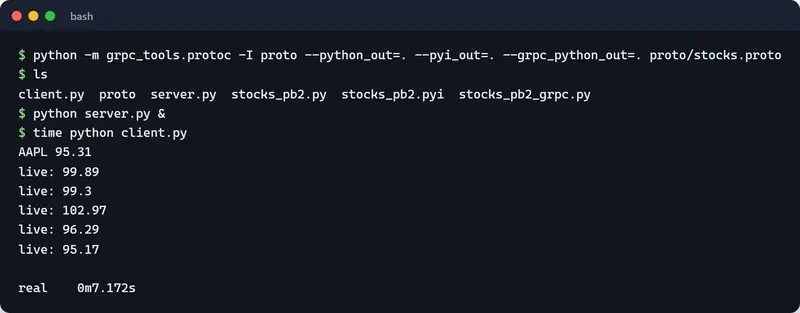
The unary GetPrice reply comes first, then the stream prints a price every second. At five seconds the deadline expires, and the client catches DEADLINE_EXCEEDED and exits cleanly.
timeout sets the gRPC deadline. There is none by default, so if the server hangs, the client waits forever. Put a deadline on every call. It's propagated to the server, which can check context.time_remaining().
A channel is expensive because it owns an HTTP/2 connection. Create one per target and reuse it for the life of the app.
Status codes and interceptors#
gRPC has its own status codes instead of HTTP ones: INVALID_ARGUMENT, NOT_FOUND, UNAVAILABLE, DEADLINE_EXCEEDED and so on. I decide what the client retries from these codes: UNAVAILABLE is usually safe to retry, INVALID_ARGUMENT never is. If you want structured details with an error, such as a retry delay or per-field violations, the grpcio-status package supports the google.rpc.Status model.
For cross-cutting work like logging, auth and metrics, use an interceptor instead of repeating code in every method. A simple token check for the asyncio server:
class AuthInterceptor(grpc.aio.ServerInterceptor):
    def __init__(self, token: str) -> None:
        self._expected = ("authorization", f"Bearer {token}")

        async def deny(request, context):
            await context.abort(grpc.StatusCode.UNAUTHENTICATED, "invalid token")

        self._deny = grpc.unary_unary_rpc_method_handler(deny)

    async def intercept_service(self, continuation, handler_call_details):
        if self._expected in (handler_call_details.invocation_metadata or ()):
            return await continuation(handler_call_details)
        return self._deny


server = grpc.aio.server(interceptors=[AuthInterceptor("s3cret")])
The client sends the token as metadata: await stub.GetPrice(req, metadata=[("authorization", "Bearer s3cret")], timeout=2). This example rejects with a unary handler; to protect streaming methods, return a handler that matches the method type. I cover the token side in my API authentication post. In production, use add_secure_port with TLS instead of add_insecure_port. A bearer token over a plaintext channel protects nothing.
Schema evolution: field numbers are forever#
On the wire, Protobuf sends field numbers, not names. So:
- Adding a field is safe. Old clients ignore fields they don't know.
- Changing a field's number or type breaks compatibility.
- When you delete a field, lock its number and name with
reserved. Protobuf doesn't do this for you, and if someone later reuses the number for a different field, old clients will misread the data.
message PriceReply {
  reserved 4;
  reserved "currency";
  string symbol = 1;
  double price = 2;
  int64 ts_ms = 3;
}
Renaming a field is fine for the binary format, but Protobuf's JSON mapping uses field names, so a gateway that converts to JSON will break. For a truly breaking change, I create a new package (package stocks.v2;) and run both versions side by side for a while.
The HTTP/2 load balancing trap#
Of all the gRPC pitfalls, this is the one I'd warn you about first. HTTP/2 multiplexes many requests over one TCP connection. A connection-level L4 load balancer, including a default Kubernetes ClusterIP service, pins that one connection to one pod, and every request from that client goes there. You run three replicas; one is on fire while two sit idle.
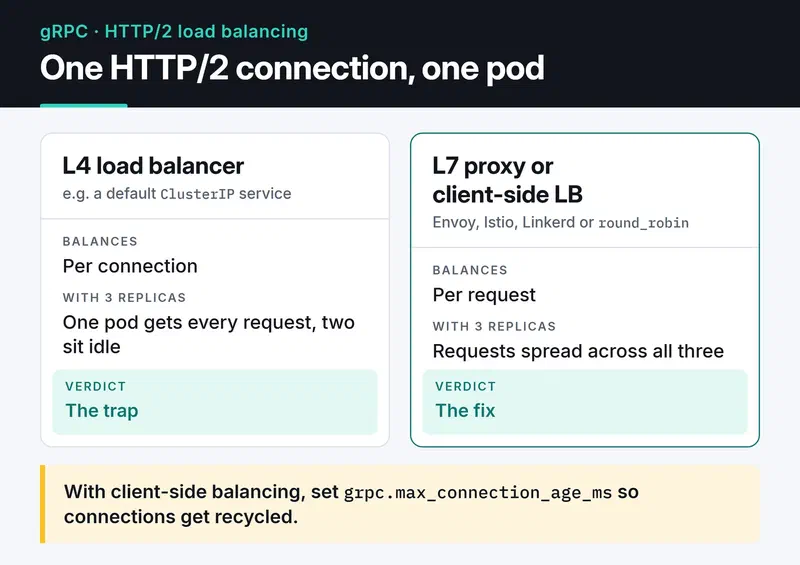
There are two fixes:
- An L7 proxy that balances per request: Envoy, a service mesh such as Istio or Linkerd, or an ingress with gRPC support.
- Client-side load balancing. In Kubernetes, a headless service returns all pod IPs from DNS, and the gRPC client connects to each and spreads requests across them:
channel = grpc.aio.insecure_channel(
    "dns:///stocks-headless.default.svc.cluster.local:50051",
    options=[("grpc.lb_policy_name", "round_robin")],
)
With the second option the client has to re-resolve DNS when pods change. Setting grpc.max_connection_age_ms on the server forces connections to be recycled periodically, which helps. I cover the Kubernetes side in my Kubernetes post.
Debugging and health checks#
REST's best feature is that you can poke anything with curl. The gRPC equivalent is grpcurl, and with server reflection enabled it can list and call methods without the .proto file. The grpcio-reflection and grpcio-health-checking packages add reflection and the standard health service that Kubernetes probes can call. I'd set up both from the start.
Browsers can't call gRPC directly because browser APIs don't expose HTTP/2 frames and trailers. If you must, use gRPC-Web through a proxy, or the Connect protocol, which speaks both gRPC and JSON. For pushing live data to a browser, WebSockets are a more natural fit.
Where to go next#
Put the .proto, server and client from this post in one folder and run them. Then add grpcio-reflection to the server and explore it with grpcurl -plaintext localhost:50051 list. The official gRPC Python docs and the asyncio API reference are the sources I trust.
If you also need to expose the service over REST, my FastAPI post covers that side, and for moving events between services, see my Kafka post.


